Best AC Gauges by Refrigerant Range and Accuracy

Refrigerant coverage, not dial size, decides which AC gauge set you should buy. Here's how six kits compare on scales, hose ratings, warranty length and what each one leaves you to buy separately.

By Sidney GrayUpdated 16 min read
On this page
- Best ac gauges for the money at a glance
- How I sorted six AC gauge sets by buyer, not by brand
- Which refrigerants does your system actually use?
- 1. VTG VOGTEN 4.5 CFM AC Vacuum Pump and Gauge Set for R134a — Best overall
- 2. Elitech Digital Manifold Gauge AC Charging Kit with R410A — Best upgrade
- 3. Orion Motor Tech OMT AC Gauge Set for R134a — Best lightweight
- 4. VIVOHOME HVAC Manifold Gauge Set for R410a R454B R32 R22 — Most versatile
- 5. Orion Motor Tech OMT 3-Way AC Gauges for R134a R12 R22 — Best budget pick
- 6. testo 550s AC Manifold Gauge Set — Best premium
- Analog dials or a digital readout: which reads better?
- What the hose rating tells you about the whole set
- What else you need before the gauges are any use
- The verdict
- FAQ
The best AC gauges for the money are the VTG VOGTEN 4.5 CFM AC Vacuum Pump and Gauge Set, because it bundles a 110V 1/3 HP pump with a three-way manifold and three 4 ft hoses in one box. If your system runs R410A or R454B instead of R134a, the VIVOHOME HVAC Manifold Gauge Set is the better buy, with four refrigerant scales on each dial.
Refrigerant coverage is the specification that splits this field, and it splits it cleanly. Three of these sets read R134a, R12, R22 and R502. Two cover the newer A2L blends. One reads 88 refrigerants. Get that wrong and the dial numbers mean nothing.
Best ac gauges for the money at a glance
| Pick | Refrigerants covered | Hose rating | Price |
|---|---|---|---|
Best overall VTG VOGTEN 4.5 CFM AC Vacuum Pump and Gauge Set |
R134a, R12, R22, R502 | 3 hoses, 4 ft | Check Price |
Best upgrade Elitech Digital Manifold Gauge AC Charging Kit |
88 claimed, incl. R1234yf | Digital, no dial hoses listed | Check Price |
Best lightweight Orion Motor Tech OMT AC Gauge Set |
R134a, R12, R22, R502 | 600 psi work, 3000 psi burst | Check Price |
Most versatile VIVOHOME HVAC Manifold Gauge Set |
R22, R410A, R454B, R32 | 800 psi work, 4000 psi burst | Check Price |
Best budget pick Orion Motor Tech OMT 3-Way AC Gauges |
R134a, R12, R22, R502 | 600 psi work, 3000 psi burst | Check Price |
Best premium testo 550s AC Manifold Gauge Set |
Most common types plus A2L | Digital, -15 to 870 psi range | Check Price |


How I sorted six AC gauge sets by buyer, not by brand
I built this shortlist around four people, because the best AC gauges for the money depend entirely on which of them you are.
- The car owner with one R134a system. You want a manifold, hoses and a can tap. You do not want a four-port aluminium block.
- The DIYer starting from nothing. You need a vacuum pump as much as you need gauges, and buying them separately costs twice.
- The homeowner with a modern split system. Your outdoor unit is charged with R410A, R32 or R454B. The classic four-refrigerant dial does not include it.
- The tech who charges by superheat and subcooling. You want temperature probes and calculated values, not mental arithmetic against a PT chart.
I compared the published specifications side by side: refrigerant scales, hose length and pressure rating, manifold port count, weight, dimensions and stated warranty. Sets that publish a hose burst pressure earned more confidence than sets that publish none. Where a claim came from a manufacturer bullet, I have said so in the write-up rather than treating it as measured.
One thing I did not weigh: dial diameter. A 68 mm face is easier to read than a 2.6 in face, but neither one changes the reading. Refrigerant coverage does.
Which refrigerants does your system actually use?
This is the question that decides your purchase, and most shoppers answer it after the box arrives.
Look at the data plate on your condenser or under your car's hood. Three of these sets list R134a, R12, R22 and R502. That covers older automotive AC and legacy R22 residential equipment, and nothing built recently. The VIVOHOME set flips the coverage entirely: R22, R410A, R454B and R32, with four scales printed on each dial and no R134a scale mentioned.
- Automotive, pre-2015 or so: R134a. The two Orion Motor Tech sets and the VTG VOGTEN kit all cover it.
- Newer vehicles: R1234yf, which only the Elitech kit claims among these six.
- Home split systems, roughly 2010 to 2024: R410A. VIVOHOME, Elitech and testo.
- New residential equipment: R454B or R32, both A2L blends. VIVOHOME lists both; testo says it supports A2L refrigerants; Elitech claims both inside its 88.
- Legacy R22 units: covered by every analog set here.
Buying the best AC gauges for the money starts with matching that plate. A four-scale dial that omits your blend is not a bargain at any position.
1. VTG VOGTEN 4.5 CFM AC Vacuum Pump and Gauge Set for R134a — Best overall
It is the only pick here that includes the vacuum pump, which is the part most first-time buyers forget they need.
Best for: a DIYer starting from nothing who needs to pull a vacuum as well as read pressures Skip it if: your system runs R410A, R32 or R454B
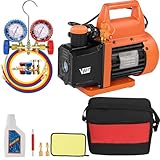
A gauge set tells you what the pressure is. It cannot remove moisture and air from a system you have opened, and that job needs a pump. VTG VOGTEN puts both in one box: a 110V 1/3 HP single-stage pump rated at 4.5 CFM, a three-way manifold gauge, three 4 ft colour-coded hoses and a low-pressure quick coupler. The listing describes an aluminium alloy casing for heat dissipation.
VOGTEN says the manifold dial gives direct readings of temperature in °F alongside pressure in psi, with a top hook for hanging it off a hood latch. The stated refrigerant coverage is R134a, R12, R22 and R502, and the model is listed as AC Vacuum Pump and Gauge Set-6.
Two figures deserve a note before you order. The hoses are 4 ft, the shortest here, where four of the other picks give you 5 ft. And the warranty is 6 months, the shortest published in this set against 1 year from three rivals and 2 years from testo. It also sells faster than anything else on this list, and only one seller stocks it.
Pros:
- Vacuum pump and manifold in one purchase
- 4.5 CFM single-stage pump, 110V and 1/3 HP
- Three 4 ft colour-coded hoses plus a quick coupler
- Aluminium alloy casing for heat dissipation
- The one buyers choose most often here
Cons:
- 6-month warranty, the shortest of the six
- 4 ft hoses, a foot shorter than most rivals
- No R410A, R32 or R454B scale
- No published weight or hose pressure rating
- Only one seller lists it
2. Elitech Digital Manifold Gauge AC Charging Kit with R410A — Best upgrade
The widest refrigerant claim in this group by a large margin, on a digital head that weighs 1.1 lb.
Best for: anyone servicing several different systems, automotive and residential, with one tool Skip it if: you want an all-mechanical tool with nothing to charge or fail
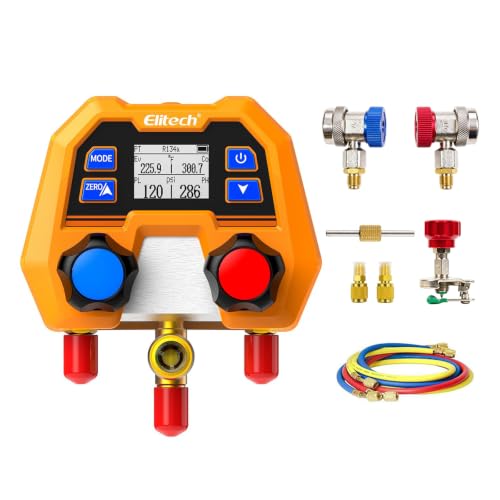
Elitech's kit claims support for 88 refrigerants, naming R410A, R32, R454B and R1234yf. That last one matters: R1234yf is the automotive blend on newer vehicles, and no other pick on this list mentions it. The listing supplies instant high- and low-side pressure readings plus saturation temperature, which is the whole reason a digital head earns its keep. You stop cross-referencing a printed chart.
The body measures 4.72 x 3.94 x 3.94 in and weighs 1.1 lb, so it drops into a pouch rather than a case. Elitech describes rugged shock-resistant housing, auto shut-off to save battery, and a data-hold function that freezes a reading while you look away. The supplied version is the 2SE with R134a couplers.
Two gaps. There is no accuracy figure published for either pressure or temperature, where testo states ±0.5% of full scale and VIVOHOME states ±1.6% on its dials. And no hose length or pressure rating appears in the specifications at all, which makes the "complete kit" bullet harder to size up than VIVOHOME's four 5 ft hoses. The 1-year warranty is standard for this group.
Pros:
- Claims 88 refrigerants including R1234yf
- Saturation temperature shown alongside pressure
- Light at 1.1 lb and compact at 4.72 in long
- Auto shut-off and data hold
- Covers both automotive and residential blends
Cons:
- No published accuracy figure
- No hose length or pressure rating listed
- Needs batteries, unlike the analog picks
- 1-year warranty against testo's 2 years
3. Orion Motor Tech OMT AC Gauge Set for R134a — Best lightweight
Bigger 68 mm dials and 5 ft hoses, in a package that measures just 3.94 in deep.

Best for: car AC work where the tool has to share a crowded toolbox Skip it if: you need a fourth port for a recovery machine
This is the second-cheapest pick here and the one I would hand to someone doing automotive work twice a year. The dials are 68 mm, the largest analog faces in this comparison, and Orion Motor Tech describes them as hybrid antishock: an oil-filled core to resist shock and wear, with a dry dial for steadier winter reading. That is a sensible compromise if the set lives in a cold garage.
The hoses run 5 ft, a foot longer than the VTG VOGTEN set, with four reinforced PVC layers rated to 600 psi working and 3000 psi burst. Included are two adjustable 1/4 in quick couplers, a 1/4 in to 1/2 in Acme adapter, and both puncture-style and self-sealing can taps, so old and new refrigerant cans both work. Refrigerant coverage is R134a, R12, R22 and R502.
Dimensions are 3.94 x 13 x 9.06 in and the warranty runs 1 year. Against the VIVOHOME set, the trade-off is stark: three ports instead of four, 600 psi hoses instead of 800 psi, and no R410A or A2L scale. This is a car tool, and it does not pretend otherwise.
Pros:
- 68 mm dials, largest analog faces in this set
- 5 ft hoses with 3000 psi burst rating
- Both puncture and self-sealing can taps included
- Hybrid oil-core, dry-dial design for cold weather
- 1-year warranty
Cons:
- Three-way manifold, no fourth port
- No R410A, R32 or R454B scale
- 600 psi working pressure, lowest published here
- Only one seller lists it
4. VIVOHOME HVAC Manifold Gauge Set for R410a R454B R32 R22 — Most versatile
The only pick built around A2L blends, with four refrigerant scales per dial and a stated ±1.6% accuracy.

Best for: residential and light commercial work on R410A, R32 or R454B systems Skip it if: you only ever touch automotive R134a
If your condenser plate reads R410A or R454B, this is where you should start. VIVOHOME lists a four-way aluminium manifold covering R22, R410A, R454B and R32, with high and low gauges showing both PSI and BAR and four refrigerant scales per dial. The stated accuracy is ±1.6%, and there is a calibration screw so you can zero the needle when it drifts. The dials are dry rather than liquid-filled, which the listing ties to stable cold-weather readings.
The fourth port matters more than the spec sheet suggests. It runs through an integrated unloading valve for controlled pressure relief, which is what lets you pull a vacuum and recover without swapping hoses mid-job. Four 5 ft PVC hoses are included, rated 800 psi working and 4000 psi burst, the highest figures published in this group. Adapters cover 5/16 in SAE, 1/2 in ACME and right- and left-hand 1/4 in SAE, plus three hose seals, a valve core and a screwdriver.
It is the heaviest pick here at 6.4 lb, in a body 8.7 x 7.1 x 2.4 in. It is also the slowest seller of the six, and it publishes no R134a scale, so automotive-only buyers gain nothing from the extra hardware.
Pros:
- Four refrigerant scales per dial, including R454B and R32
- ±1.6% stated accuracy with a calibration screw
- Four 5 ft hoses rated 800 psi working, 4000 psi burst
- Four-way manifold with unloading valve
- Dual PSI and BAR readouts
Cons:
- Heaviest of the six at 6.4 lb
- No R134a scale for automotive work
- The slowest seller in this group
- Bulkier at 8.7 in wide than either Orion set
5. Orion Motor Tech OMT 3-Way AC Gauges for R134a R12 R22 — Best budget pick
The cheapest of the six, and the only pick besides VIVOHOME stocked by more than one seller.

Best for: one R134a top-up a season on a car you already own Skip it if: you service modern home split systems
Orion Motor Tech's other set trims the dials to 2.6 in and the body to 3.54 x 8.27 x 7.48 in, which makes it the smallest and lightest analog pick at 3.53 lb. The hardware list is close to its bigger sibling: a three-way gauge, three colour-coded 5 ft hoses, two adjustable 1/4 in quick couplers, a 1/4 in to 1/2 in 29° trap adapter and both can tap styles.
The build is described as solid brass, ABS and rubber, with the same hybrid antishock gauge construction and a moisture indicator that shows coolant condition as you work. That indicator is a genuinely useful extra at this price position, because moisture in a system is the failure you cannot see on a pressure dial. Hoses carry the same 600 psi working and 3000 psi burst rating as the other Orion set.
Refrigerants covered are R134a, R12, R22 and R502, and the warranty is 1 year. The honest trade against the pick above it: smaller 2.6 in dials that are harder to read at arm's length under a hood, and no fourth port. For a single seasonal job on one vehicle, neither costs you anything.
Pros:
- The cheapest of the six
- Lightest analog set at 3.53 lb
- Moisture indicator built into the manifold
- 5 ft hoses with both can tap styles
- Brass, ABS and rubber construction, 1-year warranty
Cons:
- 2.6 in dials, smallest analog faces here
- No R410A, R32 or R454B coverage
- Three ports only
- Nothing included for pulling a vacuum
6. testo 550s AC Manifold Gauge Set — Best premium
The only pick publishing accuracy to ±0.9 °F and ±0.5% of full-scale pressure, with two wired clamp probes in the box.

Best for: a tech charging by superheat and subcooling every working day Skip it if: you check system pressures twice a year
This is the most expensive pick here, and the specification sheet explains where the money goes. Pressure range runs -15 to 870 psi, temperature -58 to 302 °F, with stated accuracy of ±0.5% of full-scale value on pressure and ±0.9 °F on temperature. Nothing else on this list publishes numbers that tight. Two wired temperature clamp probes come included, which is what turns superheat and subcooling from arithmetic into a displayed value.
testo lists Bluetooth and says the 550s supports most common refrigerants as well as A2L blends, covering both older R410A equipment and new R454B installations. The body measures 2.4 x 8.3 x 4.8 in. The warranty is 2 years from the manufacturer, double what any other pick here publishes, and it is the only set in this comparison with a stated warranty longer than 12 months.
The catch is scope. Buy it and you still need hoses matched to your work, and for occasional pressure checks you are paying for resolution and probes you will not use. It sells more slowly than the VOGTEN, Elitech and lightweight Orion sets, which fits: this is a daily-driver tool for people billing for the time it saves.
Pros:
- ±0.5% full-scale pressure and ±0.9 °F accuracy
- Two wired temperature clamp probes included
- -15 to 870 psi and -58 to 302 °F ranges
- Bluetooth, plus A2L refrigerant support
- 2-year manufacturer warranty, longest here
Cons:
- The most expensive pick in this comparison
- Needs power, unlike the three analog sets
- No hose set specified in the listing
- Overspecified for twice-a-year pressure checks
Analog dials or a digital readout: which reads better?
A dial and a display do not compete on precision. They compete on what you have to do next.
An analog manifold gives you a needle against a printed refrigerant scale. Read the pressure, find the matching temperature on the scale for your blend, then work out whether the charge is right. The two Orion sets and VIVOHOME all do this, and VIVOHOME prints four scales per dial so you are not carrying a chart.
A digital head skips the middle step. Elitech shows saturation temperature next to pressure. The testo 550s goes further and calculates superheat and subcooling from its clamp probes, which is the reading that actually tells you whether a system is properly charged.
So the split is this. If you check pressures a few times a year, a dial is fine and cheaper. If you are diagnosing rather than topping up, a digital readout saves a step on every job. Batteries are the trade: three of these picks work forever with no power, and three do not.
What the hose rating tells you about the whole set
Hose pressure numbers are the most useful published figures in this whole comparison, because they scale with how the rest of the set is built.
- VIVOHOME: 800 psi working, 4000 psi burst, four 5 ft hoses with butterfly valves
- Both Orion Motor Tech sets: 600 psi working, 3000 psi burst, three 5 ft hoses
- VTG VOGTEN: three 4 ft hoses, no pressure rating published
- Elitech and testo: no hose specifications listed
R410A runs at much higher pressures than R134a, which is exactly why the A2L-capable VIVOHOME set publishes the highest figures and the automotive-focused Orion sets publish the lowest. That is not a quality gap, it is a matched design. A 600 psi hose on a car system is appropriate; the same hose on a hot R410A condenser is not.
When a listing publishes no rating at all, that is a gap in what you know rather than proof of a weak part. It is still a reason to prefer the sets that print the number.
What else you need before the gauges are any use
Every set here except one leaves something out, and this is where "for the money" gets decided.
A vacuum pump. Open a sealed system and you have to evacuate it before recharging. Only the VTG VOGTEN kit includes a pump, and its 4.5 CFM single-stage motor is enough for automotive and mini-split work.
Adapters for your fittings. Both Orion sets include quick couplers and a 1/2 in adapter. VIVOHOME goes furthest with 5/16 in SAE, 1/2 in ACME and left- and right-hand 1/4 in SAE adapters, plus a valve core tool and three hose seals.
Can taps. Both Orion sets supply puncture-style and self-sealing taps, so cans of either generation work.
Temperature probes. Only the testo 550s includes them, and without them you cannot read superheat directly on any of these tools.
Add those up before you compare. The set that looks cheapest in isolation may not be the best AC gauges for the money once you have bought the pump separately.
The verdict
If you are a DIYer opening a system for the first time, buy the VTG VOGTEN 4.5 CFM AC Vacuum Pump and Gauge Set. The 110V 1/3 HP pump and the three-way manifold arrive together, and that single decision saves you a second purchase you would otherwise make within a week. Its 6-month warranty is the weakest here, and the hoses are 4 ft rather than 5 ft, but no rival hands you both halves of the job.
If you service home split systems, buy the VIVOHOME HVAC Manifold Gauge Set instead. Four scales per dial covering R22, R410A, R454B and R32, four 5 ft hoses rated 800 psi working and 4000 psi burst, a fourth port with an unloading valve and ±1.6% stated accuracy. That is a residential tool, and the VOGTEN set has no scale for any of those blends.
The cutoff is the refrigerant on your data plate. R134a, R12, R22 or R502 sends you to VOGTEN or either Orion set. R410A, R32 or R454B sends you to VIVOHOME. R1234yf sends you to Elitech, the only pick that names it. And if you bill for superheat and subcooling work every day, the testo 550s earns its position with ±0.5% full-scale pressure accuracy, two clamp probes and a 2-year warranty.
FAQ
Are cheap AC gauges accurate enough for DIY work?
Cheap AC gauges are accurate enough for spotting a low charge or a blocked orifice on a car system. The budget Orion Motor Tech set uses a hybrid oil-core dial with a moisture indicator, which covers most home garage diagnostics. For charging by superheat, you want a published accuracy figure, and only testo at ±0.5% and VIVOHOME at ±1.6% supply one.
Is a digital manifold worth it over analog dials?
A digital manifold is worth it if you diagnose rather than top up. The Elitech kit shows saturation temperature next to pressure, and the testo 550s calculates superheat and subcooling from two clamp probes. That removes a lookup step on every reading. Check pressures twice a year and a three-scale analog dial does the same job with no batteries to manage.
Will an R134a gauge set work on my home R410A system?
An R134a gauge set will not read your home R410A system correctly. The dial scales are printed for specific blends, and R410A runs at much higher pressures than R134a. Use the VIVOHOME set, which lists R22, R410A, R454B and R32 with four scales per dial and hoses rated 800 psi working, or the Elitech kit that claims 88 refrigerants.
VTG VOGTEN or VIVOHOME: which set should I buy?
Choose between VTG VOGTEN and VIVOHOME on refrigerant, not features. VOGTEN covers R134a, R12, R22 and R502 and includes a 4.5 CFM vacuum pump, which VIVOHOME does not. VIVOHOME covers R22, R410A, R454B and R32 across a four-way manifold with 800 psi hoses. Automotive work goes to VOGTEN. Modern residential systems go to VIVOHOME.
What mistake do first-time AC gauge buyers make?
The mistake first-time buyers make is treating gauges as the whole toolkit. Reading pressure is only half the job. Once you open a system you must evacuate it, and a manifold cannot do that. Five of these six picks include no pump at all. Check whether a vacuum pump, adapters and can taps are in the box before you compare anything else.
Start with your data plate, not with a product page. Walk out to the condenser or pop the hood, read the refrigerant printed on the label, then come back and match it. That single check eliminates half of this list before you spend anything. For most people opening a system for the first time, the VTG VOGTEN kit is the sensible default, because it is the one purchase that leaves you with nothing else to buy before you start work. Everyone else should follow the refrigerant to the set built for it.