Best Brushless Belt Sander for a One-Battery Shop

A brushless belt sander is only as useful as the battery platform it fits. Here's how five cordless models compare on belt speed, arm travel, weight and what each one actually sands.

By Sidney GrayUpdated 15 min read
On this page
- Best brushless belt sander at a glance
- How I screened the field down to five
- Wide belt or bandfile: which brushless belt sander do you need?
- Does the battery platform decide it for you?
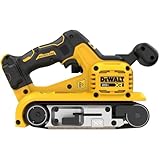
- 1. DEWALT 20V MAX Belt Sander (DCW220B) — Best overall
- 2. Eastyle Upgraded Brushless Belt Sander — Best for heavy use
- 3. DEWALT 20V MAX XR Bandfile (DCM200B) — Best for families
- 4. VERVEWAVE 20V Cordless Bandfile — Best budget pick
- 5. RKBUDOL Detail Belt Sander (M18) — Best compact
- What more money buys in a brushless belt sander
- What the listings do not tell you
- The verdict
- FAQ
The best brushless belt sander here is the DEWALT DCW220B, because a 3 x 18 in belt with a 25-position speed dial covers more flat surface per pass than anything else in this group. If your work is tube, weld cleanup and tight radii instead of flat panels, the DEWALT DCM200B bandfile with its 104° rotating arm is the better buy. The two sit at the top of this price range, and each tier below buys something different: mid-range gets you belts in the box and a long warranty, entry-level gets you a brushless motor and little else.
Best brushless belt sander at a glance
| Pick | Belt speed / travel | Weight | Price |
|---|---|---|---|
Best overall DEWALT 20V MAX Belt Sander (DCW220B) |
25-speed dial, 3 x 18 in belt (claim) | 1 lb listed | Check Price |
Best for heavy use Eastyle Upgraded Brushless Belt Sander |
1247 FPM, 6 speeds (claim) | 5 lb | Check Price |
Best for families DEWALT 20V MAX XR Bandfile (DCM200B) |
5,600 ft/min, 104° arm (claim) | 3.66 lb | Check Price |
Best budget pick VERVEWAVE 20V Cordless Bandfile |
3268 ft/min, 170° arm (claim) | Not listed | Check Price |
Best compact RKBUDOL Detail Belt Sander (M18) |
2067 ft/min, 100° arm (claim) | Not listed | Check Price |


A note on the weight column: DEWALT lists the DCW220B at 1 lb, which is a shipping-data figure rather than a tool weight for a 3 x 18 in sander. Treat it as unreliable and read the 8.66 x 13.4 x 6.69 in dimensions instead.
How I screened the field down to five
Every pick here runs a brushless motor and every one ships as a bare tool. That is the whole category as Amazon returns it, and it matters more than it sounds.
I started from published specifications only: dimensions, weight, warranty, model number, and the speed figures each brand prints on the listing. Then I cut anything that muddied the comparison.
- Corded models were out. A brushless motor is a cordless design decision. Every survivor runs on an 18V or 20V pack.
- Kits with batteries were out. Mixing tool-only listings with battery-included bundles makes the price positions meaningless.
- Anything with no published dimensions was out. If I can't tell whether it clears a stair riser, I can't recommend it.
What survived splits cleanly into two tool types, which is the real story of this group and the reason the middle sections below are shaped the way they are. Two are wide-belt flat sanders. Three are bandfiles, narrow-belt tools with a pivoting arm.
One more screening note. Three of the five are house brands, and two of those three publish no weight figure at all. That is not disqualifying, but it does change what you can verify before you buy.
Wide belt or bandfile: which brushless belt sander do you need?
This is the decision, and most guides skip it because both tool types share the same category name.
A wide-belt sander drags a 3 x 18 in loop across a flat surface. It flattens. It levels glue lines, it strips paint off siding, it takes a rough tabletop down to something you can finish. The DCW220B is this shape, and DEWALT's listing claims 16.7% more sanding surface area than a competing 3 x 18 in cordless model.
A bandfile runs a narrow belt on a pivoting arm. It gets into places. Weld beads, pipe joins, inside corners, the underside of a railing. The DCM200B, the VERVEWAVE and the RKBUDOL are all this shape, with arm travel listed at 104°, 170° and 100° respectively.
Here's the trick: they are not substitutes. A bandfile will take a week to flatten a door. A wide-belt sander physically cannot reach a fillet weld. Buying the wrong one is the single most common way to waste money in this category.
Ask yourself one question. Is the surface you're sanding flat and wider than your hand? Wide belt. Is it curved, welded, or in a corner? Bandfile. If the honest answer is both, buy the bandfile second, because it's the tool you'll reach for less often.
Does the battery platform decide it for you?
Often, yes. Four of these five run on DEWALT 20V MAX packs. One runs on Milwaukee M18.
That single line eliminates more picks for more shoppers than any performance figure. If you already own three DEWALT batteries and a charger, the RKBUDOL is not a candidate no matter how it's specified, and the reverse is true if your shelf is red.
- DEWALT 20V MAX platform: DCW220B, DCM200B, Eastyle MFBS01, VERVEWAVE WT8841-12
- Milwaukee M18 platform: RKBUDOL CBS01-M
Eastyle goes furthest here, stating compatibility with both DEWALT 20V MAX and 60V packs, which means a FLEXVOLT battery you bought for a circular saw will run it.
Two cautions on third-party compatibility. First, these are aftermarket tools claiming to accept a first-party battery, not licensed products, so battery-side firmware or a warranty question is your risk to carry. Second, none of them include a battery or charger. The VERVEWAVE listing shouts this three exclamation marks deep, and the others say it more quietly, but it applies to all five. Budget for the pack if you don't own one.
1. DEWALT 20V MAX Belt Sander (DCW220B) — Best overall
The only wide-belt brushless belt sander here from a first-party brand, with the finest speed control in the group.
Best for: flattening tabletops and deck boards on a DEWALT 20V battery Skip it if: your work is tube, weld and corner detail
What separates this from the other four is belt area. DEWALT states a 3 x 18 in belt and claims 16.7% more sanding surface than a named Milwaukee competitor, which is the kind of comparison that only matters when you're covering square footage. On a workbench top or a run of deck boards, that surface area is the difference between an afternoon and a weekend.
The speed control is the second differentiator, and it's a real one. A 25-position selection dial paired with a variable-speed trigger gives you far more graduation than the 6-speed switches on the other picks. That matters when you drop from an aggressive 80 grit pass to a 120 grit finishing pass and don't want to burn the surface.
DEWALT also claims up to 95% dust collection efficiency through its tool-free port, though the AirLock connector needed for that is sold separately. Factor that in. The published dimensions of 8.66 x 13.4 x 6.69 in tell you this is a two-handed tool with a real footprint.
The trade-off against the bandfiles is reach. This body cannot follow a curve or enter a corner, and it sits at the most expensive position in this group.
Pros:
- Widest sanding surface in this set at 3 x 18 in
- 25-position speed dial, finest control here
- Tool-free quick-release belt change
- First-party DEWALT with manufacturer warranty
- Claimed 95% dust collection efficiency
Cons:
- Most expensive pick here
- Cannot reach welds, corners or curves
- AirLock dust connector sold separately
- Listed weight of 1 lb is clearly a data error
- Battery and charger not included
2. Eastyle Upgraded Brushless Belt Sander — Best for heavy use
The only pick in this group with a published 5 Year Warranty, and the only one that arrives with belts in the box.

Best for: long sanding sessions where a 5 year warranty matters Skip it if: you need a name-brand service network
Two things make this the pick for someone who plans to use a sander hard. The 5 Year Warranty is the longest stated coverage of the five, and it's the only one expressed as a number of years rather than the vague "Manufacturer Warranty" on the DEWALT listings. If a brushless motor is going to fail, five years of stated cover is worth something.
The second is the belt assortment. Eastyle includes ten 3 x 18 in aluminium oxide belts: four at 80 grit, four at 100 grit, two at 120 grit. That's a genuinely usable progression from stock removal to finish prep, and it means your first project doesn't need a second order.
Eastyle claims 6 variable speeds up to 1247 FPM, single-lever belt changes in under 3 seconds, and a flat-side body for flush sanding against walls and stair risers. That last claim is the one I'd weigh most heavily if you're refinishing stairs, since the DCW220B's housing doesn't advertise it. Dust handling is a bag rated by Eastyle at 85% capture, with a universal adapter for a 1-1/4 in or 35mm shop vac hose.
At 5 lb and 6.7 x 7 x 5.7 in it's a compact wide-belt body. The honest trade-off is brand: no dealer network, no local service counter, and the warranty is only as good as the seller behind it.
Pros:
- Longest published warranty here at 5 years
- Ten 3 x 18 in belts included across three grits
- Runs DEWALT 20V MAX and 60V packs
- Flat-side body for flush sanding, per Eastyle
- Shop vac adapter included
Cons:
- House brand with no service network
- Sells slower than every pick except the RKBUDOL
- Only one seller lists it
- 6 speeds versus 25 positions on the DCW220B
- Dust bag capture claim of 85% is lower than DEWALT's
3. DEWALT 20V MAX XR Bandfile (DCM200B) — Best for families
The fastest belt speed in this group at a claimed 5,600 ft/min, on a first-party bandfile body.

Best for: a shared shop doing metal cleanup and tight-radius work Skip it if: you mainly flatten wide flat panels
This is the tool for a household where more than one person picks up the sander and nobody wants to think about which battery fits. It runs the same 20V MAX packs as most DEWALT cordless gear, weighs 3.66 lb, and measures 5.55 x 11.7 x 6.65 in, so it's a one-handed tool for most adults.
DEWALT states 700 MWO of power and belt travel up to 5,600 ft/min, the highest figure printed on any listing here. On a bandfile that speed is doing a specific job: knocking down weld beads and scale on steel without stalling. The 104° rotating arm is less travel than the VERVEWAVE claims, but it includes a stated storage position, which on a shared bench means the arm folds out of the way instead of catching on things.
The changeable contact arm is the feature I'd flag for a mixed-use shop. Swap the arm and the same tool handles a different radius, which matters when one person is cleaning up tube and another is easing an inside corner. Speed control comes from both a dial and the trigger.
Against the DCW220B, this cannot flatten. Narrow belts on a pivoting arm chase contours, they don't level surfaces, and this is the second-most expensive pick here.
Pros:
- Highest claimed belt speed here at 5,600 ft/min
- 104° rotating arm with a storage position
- Changeable contact arm for multiple radii
- One-handed at 3.66 lb
- First-party DEWALT with manufacturer warranty
Cons:
- No good at flattening wide flat surfaces
- Less arm travel than the VERVEWAVE's claimed 170°
- Second-highest price position in this set
- No belts included
- No dust collection stated on the listing
4. VERVEWAVE 20V Cordless Bandfile — Best budget pick
The cheapest pick here, and the one with the most arm travel at a claimed 170°.

Best for: occasional weld cleanup and hard-to-reach spots Skip it if: you want a published warranty and full specs
The number that earns this its place is 170° of arm rotation, more than either DEWALT bandfile advertises. VERVEWAVE also describes the arm as telescopic and tool-free adjustable, which is a combination none of the others claim. If your problem is a joint you can see but can't get a tool to, this is the geometry that solves it.
The body measures 3.74 x 20.1 x 4.53 in. That 20.1 in length is the arm extended, and it's the longest reach here by a wide margin. VERVEWAVE claims a maximum belt speed of 3268 ft/min from a pure copper brushless motor and six speed settings covering 4 to 16.6 m/s, spanning wood panels through iron plate. The listing counts 6 in the pack, which on a bandfile listing most likely means belts, though the wording doesn't say.
Belt changes are tool-free. Two sellers list it, and it moves faster than three of the other four picks despite being the cheapest, which tells you something about where shoppers land when a bandfile is a secondary tool.
The gaps are real. No warranty is published, no weight is listed, and the specification set is the thinnest here. On a cheap tool you're buying reach and accepting uncertainty.
Pros:
- Cheapest pick in this group
- Most arm travel here at a claimed 170°
- Telescopic tool-free arm adjustment
- 6 speeds spanning wood and iron plate
- Sells faster than three pricier picks here
Cons:
- No warranty published on the listing
- No weight figure given
- Thinnest specification set of the five
- Slower claimed belt speed than the DCM200B
- Unclear what the count of 6 includes
5. RKBUDOL Detail Belt Sander (M18) — Best compact
The only Milwaukee M18 pick here, and the smallest body of the five.

Best for: Milwaukee M18 owners doing one-handed detail work Skip it if: you own DEWALT batteries
If your shelf is full of red batteries, this is your entry into this category, because it's the only pick that fits them. RKBUDOL states compatibility with Milwaukee M18 18V lithium-ion packs, tool only, no battery or charger.
The other thing it has is size. At 7 x 5 x 6.5 in this is the smallest footprint in the group, smaller than the Eastyle wide-belt body and less than half the length of the extended VERVEWAVE. RKBUDOL positions it explicitly for one-hand operation in tight spaces, which is what a detail bandfile should be. The arm pivots up to 100°, and the listing claims 2067 ft/min belt speed from a brushless motor with 6 adjustable speeds for wood, metal and plastic.
That belt speed figure is the lowest claimed here, well under the DCM200B's stated 5,600 ft/min. On a detail tool that's a defensible choice, since heat and control matter more than removal rate when you're working a small area. It's also the second-cheapest pick.
Two sellers list it and it's the slowest seller of the five by a long way, so it's an unproven listing on top of being a house brand. No weight, no warranty, no dust collection stated.
Pros:
- Only Milwaukee M18 pick in this group
- Smallest body here at 7 x 5 x 6.5 in
- Second-cheapest pick
- 100° pivoting arm and 6 speeds
- Rated by RKBUDOL for wood, metal and plastic
Cons:
- Useless if you own DEWALT batteries
- Lowest claimed belt speed at 2067 ft/min
- Slowest seller of the five
- No warranty, weight or dust collection published
- Less arm travel than the VERVEWAVE
What more money buys in a brushless belt sander
The three price tiers in this set buy three different things, and none of them is raw speed.
Entry tier. The VERVEWAVE and the RKBUDOL both give you a brushless motor, six speeds and a pivoting arm. What you don't get is a published warranty, a stated weight, or a service path. The VERVEWAVE actually beats both DEWALTs on claimed arm travel at 170°, which is a reminder that the cheapest tool can win a specific spec outright.
Mid tier. The Eastyle buys you documentation and consumables. A 5 Year Warranty, ten belts, a shop vac adapter and a full dimensional spec. Per hour of use, that combination is arguably the best value here.
Premium tier. Both DEWALTs buy you first-party engineering and a dealer you can walk into. The DCW220B adds a 25-position speed dial nothing else matches and a 95% dust collection claim. The DCM200B adds 5,600 ft/min and a swappable contact arm.
The pattern is that money buys control, coverage and recourse. It does not buy a faster belt.
What the listings do not tell you
Four things you'll want to know that no listing in this group states.
- Nobody publishes noise figures. A brushless belt sander at 3268 ft/min is loud enough for hearing protection regardless.
- Battery runtime is never quantified. Eastyle claims "up to 22% more runtime" and DEWALT claims "up to 22% more power", both against unnamed baselines. Neither tells you minutes per charge, and both depend entirely on the amp-hour rating of the pack you supply.
- Belt sizes are stated inconsistently. The DCW220B and Eastyle both name 3 x 18 in. The three bandfiles don't publish a belt size at all, which makes ordering replacements a guessing game until the tool arrives.
- Dust collection is optional on most of them. Only the DCW220B and the Eastyle describe a dust system. If you're sanding indoors, the other three will put everything they remove into the air.
The bandfile belt size gap is the one I'd chase down with the seller before buying, because consumables cost more over a tool's life than the tool does.
The verdict
Take the three price tiers in turn, because each one has a clear winner.
At the premium end, the DEWALT DCW220B is the best brushless belt sander in this group for anyone sanding flat surfaces. The 3 x 18 in belt and 25-position speed dial give it both the coverage and the finish control no other pick offers, and the 95% dust collection claim matters if you work indoors. Its stablemate the DCM200B takes the same tier for metalwork instead, with a claimed 5,600 ft/min and a 104° arm that goes where the DCW220B cannot.
In the middle, the Eastyle is the value pick of the whole set. A 5 Year Warranty, ten belts across three grits, DEWALT 20V and 60V compatibility, and a flat-side body for flush sanding. You give up brand recourse and 19 speed positions to get it.
At the entry end, the answer depends on your battery. DEWALT owners take the VERVEWAVE for its claimed 170° arm and 20.1 in reach. Milwaukee M18 owners take the RKBUDOL, which is the only pick that fits their packs and the most compact body here at 7 x 5 x 6.5 in.
The cutoff is simple: flat panels means the DCW220B, contours means a bandfile.
FAQ
Is a brushless belt sander worth it over a corded one?
A brushless belt sander is worth it when cord reach is your constraint, not power. DEWALT claims the DCW220B completes traditionally corded applications, and the Eastyle claims corded-class power. You give up guaranteed runtime and you must supply a battery. For a fixed bench with an outlet nearby, corded still makes sense.
Which brushless belt sander gives the best value for the money?
Best value for the money in this group goes to the Eastyle MFBS01. It sits at the mid price position but includes ten 3 x 18 in belts across 80, 100 and 120 grit, a shop vac adapter, and a 5 Year Warranty that no other pick here matches. Those inclusions are what you'd otherwise buy separately.
What belt size do these sanders use?
The belt size is published for two of the five. The DEWALT DCW220B and the Eastyle both use 3 x 18 in belts, the standard wide-belt format. The three bandfiles, from DEWALT, VERVEWAVE and RKBUDOL, don't state a belt size on their listings, so confirm it with the seller before ordering consumables.
DCW220B or DCM200B: which DEWALT should I buy?
Between the DCW220B and DCM200B, the answer is your surface. The DCW220B runs a 3 x 18 in belt for flattening panels, doors and deck boards, with a 25-speed dial. The DCM200B is a bandfile with a 104° rotating arm and a claimed 5,600 ft/min, built for welds, pipe and corners. They don't overlap.
What mistake do first-time buyers make in this category?
The most common mistake is buying a bandfile expecting it to flatten a tabletop, or a wide-belt sander expecting it to reach a weld. The second is forgetting every pick here ships bare. No battery, no charger. Check your existing platform first, then check the tool type against the surface you actually need to sand.
Work out which of the two tool shapes your next project needs, then check what batteries are already on your shelf. Those two answers narrow five picks to one or two in about a minute. If both answers point at flat surfaces and DEWALT 20V packs, the DCW220B is the default for a reason that has nothing to do with brand: no other pick in this group gives you 25 speed positions and 3 x 18 in of belt at once, and those are the two things that separate a sanded surface from a scarred one.