Best Brushless Oscillating Multi Tool: DeWalt Wins

Five brushless cordless multi-tools compared by weight, OPM range, warranty and speed control. The DeWalt DCS356B leads; a Milwaukee premium option and a WORKPRO entry pick fill in the gaps.

By Sidney GrayUpdated 14 min read
On this page
- Best brushless oscillating multi tool at a glance
- How I screened the field down to five
- 1. DeWalt DCS356B — Best overall
- 2. Milwaukee 2836-20 M18 FUEL — Best premium
- 3. DeWalt DCS356C1 Kit — Best for pros
- 4. WORKPRO W125282AE — Runner-up
- 5. Synxiter Cordless Oscillating Tool — Best budget pick
- What actually decides a brushless multi-tool?
- Bare tool or kit: which should you buy?
- Blade compatibility and the universal adapter question
- What the listings do not tell you
- The verdict
- FAQ
The best brushless oscillating multi tool for most buyers is the DeWalt DCS356B, a 2.4 lb bare tool with a three-speed selector that runs 0–13,000, 0–17,000 and 0–20,000 OPM under a 3-year limited warranty. If you cut hardwood or thick metal every day, the Milwaukee 2836-20 M18 FUEL is the better call for its 4.2° oscillation angle and vibration dampening. Both are brushless, both take first-party batteries, and both sit inside professional platforms most buyers already own.
A quick honesty note before the table. Amazon's results for this query include tools whose brushless status is only claimed in the listing text, so treat every "brushless" label here as the manufacturer's, not an independent measurement.
Best brushless oscillating multi tool at a glance
| Pick | Weight | Speed control | Price |
|---|---|---|---|
Best overall DeWalt DCS356B |
2.4 lb | 3-speed, 0–20,000 OPM | Check Price |
Best premium Milwaukee 2836-20 M18 FUEL |
3.09 lb | Variable dial, 4.2° angle claim | Check Price |
Best for pros DeWalt DCS356C1 Kit |
3 lb | 3-speed, up to 20,000 OPM claim | Check Price |
Runner-up WORKPRO W125282AE |
Not listed | 6-speed, up to 19,000 OPM claim | Check Price |
Best budget pick Synxiter for DeWalt 20V |
2.71 lb | 6-speed, 6,000–21,000 OPM claim | Check Price |



How I screened the field down to five
I started from the criteria a buyer of a brushless oscillating multi tool actually applies, then set weights.
- Brushless motor confirmed in the listing text, weighted first because it is the whole point of the search.
- Cordless 18V or 20V class, weighted second because corded oscillating tools solve a different problem.
- A published weight and dimensions, weighted third because these tools live in one hand for long spells.
- A speed control system named in specifications or features, weighted fourth because a single-speed multi-tool is not what buyers of this category are shopping for.
Anything that failed the first two was cut. Anything that passed the first two but hid the last two dropped down the ranking rather than out of it. That is how the WORKPRO stayed in without a published weight, and it is why the Synxiter, a third-party body built for a DeWalt battery, sits at the bottom of the list rather than off it entirely.
A few well-known models did not make the shortlist because the current listings did not carry a clear brushless declaration in the specification block. That is the honest reason, not a judgment on the tools themselves.
1. DeWalt DCS356B — Best overall
The DCS356B is the lightest tool here and the only pick pairing a three-speed selector with a full 20,000 OPM ceiling in DeWalt's own housing.
Best for: DIYers already on the DeWalt 20V platform who want the lightest capable tool. Skip it if: you have no batteries or charger and want a one-box solution.
At 2.4 lb and 3.07 x 12 x 6.61 in, this is the smallest and lightest tool in the set. That matters when you are cutting a nail flush against a joist above your head, or reaching into a cabinet base for a plumbing pass-through. The three preset speeds at 0–13,000, 0–17,000 and 0–20,000 OPM give you a coarse-to-fine ladder without asking you to eyeball a dial. DeWalt claims the brushless motor delivers up to 57% more runtime than its brushed equivalent, and the tool ships with a universal accessory adapter and a quick-change blade system. The 3-year limited warranty is the longest published in this set. The catch is straightforward. This is a bare tool. No battery, no charger, no blade set beyond the two wood cutting blades named in the listing. Against the kit version below, this pick trades a box of accessories for a lower entry cost and a lighter footprint.
Pros:
- Lightest in the set at 2.4 lb
- Three-speed selector spans 0–13,000 to 0–20,000 OPM
- 3-year limited warranty, the longest here
- Universal accessory adapter for third-party blades
- Quick-change blade system needs no wrench
Cons:
- Bare tool, no battery or charger
- Only two wood blades included
- Locked to the DeWalt 20V platform
2. Milwaukee 2836-20 M18 FUEL — Best premium
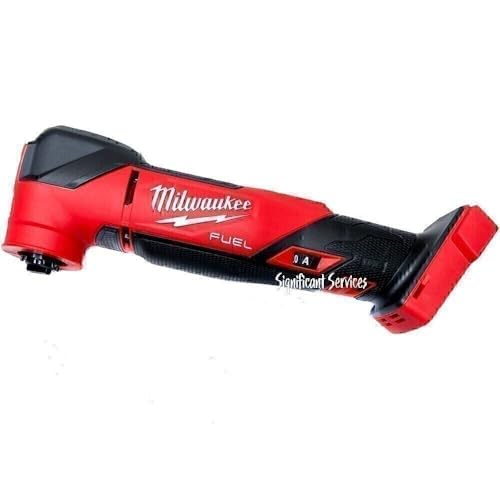
The Milwaukee is the only pick that names an oscillation angle and vibration dampening as engineered features, and it is built for hours-a-day work.
Best for: trade users who cut all day and need vibration dampening. Skip it if: you want a longer warranty for the money spent.
The 2836-20 weighs 3.09 lb and measures 3 x 13 x 5 in. Milwaukee lists a 4.2° oscillation angle for what the listing calls the fastest cutting, an auto-load feature that ramps speed once a blade meets material, and a 180° span LED for low-light work. A variable speed dial replaces the three-preset approach the DeWalt uses, which is a preference call rather than a right-or-wrong one. Vibration dampening is the specification that separates this pick from the rest of the set: after an hour of undercutting door jambs, the difference in hand fatigue is where premium money goes. The most expensive pick here also carries the shortest published warranty in this set, at 1 year manufacturer, against DeWalt's 3-year limited on both DCS356 tools. That is the trade to be honest about. This pick is bought for the ergonomics and the M18 platform, not for the paper coverage.
Pros:
- Vibration dampening called out in the listing
- 4.2° oscillation angle claim
- 180° span LED for corners and cabinet backs
- Auto-load speed ramp under load
- Variable speed dial rather than fixed presets
Cons:
- 1-year warranty, shortest in the set
- Highest price position of the five
- Heavier than either DeWalt at 3.09 lb
3. DeWalt DCS356C1 Kit — Best for pros
The DCS356C1 is the DCS356 head bundled with a battery, a charger and blades, so a first-time DeWalt buyer walks out ready to cut.

Best for: first-time buyers who need the tool, a battery and a charger together. Skip it if: you already own DeWalt 20V batteries.
Mechanically, this is the same platform as the winner. Three-speed selector, brushless motor, universal accessory adapter, quick-change blades, LED work light, 3-year limited warranty. What changes is the box. The kit dimensions of 9.75 x 14.4 x 4.8 in and 3 lb reflect the packaged weight, not the tool alone, so weight is not a fair comparison against the bare DCS356B. The reason this pick lands above the two entry-tier tools and below the DCS356B is straightforward. It is the second-most-expensive pick here, and the extras it adds are exactly the extras a shopper without the platform needs. Against the winner, it trades a lighter total spend for a slower start. Against the Milwaukee, it trades the vibration dampening and the auto-load feature for a longer warranty. If you are already on DeWalt 20V and have a spare battery, buy the winner and skip this one; if you are not, this is where the DeWalt story starts.
Pros:
- Battery, charger and blades in one box
- Same three-speed brushless head as the DCS356B
- 3-year limited warranty
- Quick-change accessory system, no wrench needed
- Universal accessory adapter for third-party blades
Cons:
- Second-highest price position in the set
- No point paying up if you already own DeWalt batteries
- Kit weight of 3 lb obscures the tool's own weight
4. WORKPRO W125282AE — Runner-up
The WORKPRO offers the widest speed selector count in this set at six, and it undercuts both DeWalt tools on price position.

Best for: occasional users buying into a fresh cordless platform on a budget. Skip it if: you need a published warranty or the widest speed range.
WORKPRO's brushless head is rated to 19,000 OPM in the listing, controlled by a six-speed selector rather than DeWalt's three or Milwaukee's dial. The dimensions are 5.31 x 14.8 x 5.91 in, and the case colour scheme is grey, green and black. Tool-less blade changes and an LED are both called out. The reasons this is a runner-up rather than the winner sit in the specification block, not the marketing copy. There is no published weight, and there is no published warranty. Both DeWalts carry a 3-year limited warranty in the specification block, and the Milwaukee carries 1 year, so a blank in this row is not neutral, it is worse than either. Against the DeWalts, this pick trades platform, weight transparency and coverage for a lower price position; against the Milwaukee, it trades the auto-load and vibration dampening for the same. That is the honest read.
Pros:
- Six variable-speed selector, most steps in the set
- Tool-less blade changes
- Entry price band position
- LED work light
- 19,000 OPM top-end claim
Cons:
- No published warranty
- No published weight
- Not on a mainstream battery platform
5. Synxiter Cordless Oscillating Tool — Best budget pick
The Synxiter is the cheapest pick here, a third-party body that runs on DeWalt 20V batteries and lands with a 22-piece accessory bundle.

Best for: DeWalt 20V battery owners who want a cheap second tool and a stack of blades. Skip it if: you want a first-party warranty and support.
The Synxiter weighs 2.71 lb, uses a six-speed brushless head rated at 6,000 to 21,000 OPM in the listing, and ships with a bundle that the listing describes as 22 pieces, including three straight saw blades, a segment saw blade, a flexible scraper and a sanding pad. The listing is explicit that the tool takes DeWalt 20V batteries but no battery is included. This pick exists for a specific scenario. You are already deep in DeWalt 20V, you have spare batteries in a drawer, and you want a dedicated multi-tool for occasional grout removal or a punch list without paying DeWalt's own price. Against the DCS356B, it trades a longer warranty, brand-backed service and a first-party fit for a much lower entry cost and a bigger accessory pile. Against the WORKPRO, it trades a standalone battery platform for compatibility with batteries you may already own.
Pros:
- Cheapest of the five
- Six-speed brushless motor, 6,000–21,000 OPM claim
- Runs on DeWalt 20V batteries you may already own
- 22-piece accessory bundle
- Bright LED called out in the listing
Cons:
- Third-party body without a published warranty
- No battery included despite the platform pitch
- Slowest seller of the five in this set
What actually decides a brushless multi-tool?
Most guides to a best brushless oscillating multi tool lead with OPM, the oscillations per minute figure. That number is a ceiling, not a decision. Every tool in this set claims a top speed between 19,000 and 21,000 OPM. The gap is 10%, and it disappears the moment the blade meets material.
Three specifications actually decide it.
- Weight, in your hand. 2.4 lb for the DCS356B, 2.71 lb for the Synxiter, 3.09 lb for the Milwaukee. Over an hour of overhead cuts, the lightest tool wins.
- How speed is controlled. A three-position selector, a six-position selector or a continuous dial. This is a preference, not a hierarchy, but it is a real decision.
- Oscillation angle. Only the Milwaukee names one at 4.2°. A wider angle removes more material per stroke and cuts faster; a narrower angle gives more control on flush cuts. If a listing does not publish this figure, treat the tool as middle-of-the-road.
Runtime claims like "up to 57% more" are relative to the same brand's brushed tool, not to any other tool in this comparison. Read them as a reason to prefer brushless over brushed, not as a way to rank two brushless tools.
Bare tool or kit: which should you buy?
Two of the five picks come in both forms, and the choice is not about which is better, it is about what you already own.
Buy the bare tool if any of the following is true. You already have two or more 20V batteries on the same platform. You have a working charger on your bench. You have blades from another oscillating tool with a universal fitting. In those cases, paying for a kit is paying twice.
Buy the kit if you are starting the platform, if your existing batteries are all older packs that no longer hold a full charge, or if you want a single receipt for warranty purposes. The DCS356C1 makes this trade explicit: the same head as the DCS356B, plus a battery, a charger and blades, at the second-highest price position in this set. That is a fair swap when you need everything, and a poor one when you already have most of it.
The Milwaukee here is bare-tool only in this data, which makes it a clean choice for someone already on M18.
Blade compatibility and the universal adapter question
Blade fit is the quiet variable that decides whether an oscillating tool stays useful.
The two DeWalt tools both call out a universal accessory adapter designed to accept most third-party blades. That is the most permissive setup in this set, and it matters because blade prices vary widely by brand. The DCS356 kit adds an unspecified set of starter blades to the two-blade bare kit.
The WORKPRO listing describes a tool-less, flip-and-press blade change but does not label the fit as universal. The Synxiter promises third-party DeWalt battery compatibility and ships with 22 accessory pieces of its own, which will get most first jobs done without a separate blade order.
Milwaukee's listing focuses on the motor and the geometry rather than the fit, so treat blade compatibility with the M18 tool as something to check on the specific blades you plan to use.
If you own a stockpile of oscillating blades already, the two DeWalts are the safest bet. If you have none, the Synxiter's bundle is the shortest path to a working set.
What the listings do not tell you
Three things are missing from all five listings, and they are worth naming so you can ask the seller or check a manual before buying.
- Battery runtime on a specific cut. DeWalt cites 57% more runtime than its brushed model, and Milwaukee does not quote a number here. Neither tells you how many linear feet of oak trim you get per charge, because the answer depends on the battery.
- Sound level in dB. None of the listings publish a decibel figure. Oscillating tools are loud; assume ear protection is required.
- Replacement part availability. DeWalt and Milwaukee both operate service networks tied to the tools' 3-year and 1-year warranties. Third-party bodies like the Synxiter carry no such published pathway.
Two smaller things worth flagging. The DeWalt DCS356C1 kit dimensions of 9.75 x 14.4 x 4.8 in describe the box, not the tool. And "brushless" in an Amazon title is a listing claim, so if brushless is a hard requirement, check the specification block on the page before you order.
The verdict
The best brushless oscillating multi tool for most buyers is the DeWalt DCS356B. It is the lightest tool in the set at 2.4 lb, it carries the joint-longest published warranty at 3 years, it runs to 20,000 OPM across three preset speeds, and it takes universal accessory blades. If you already own DeWalt 20V batteries, that is the entire argument.
Two conditions flip the recommendation. First, if you cut hardwood, thick nails or metal for hours a day, the Milwaukee 2836-20 M18 FUEL is worth the higher price for its 4.2° oscillation angle claim and its vibration dampening, provided you accept the 1-year warranty. Second, if you have no cordless platform at all, the DCS356C1 kit is the cleaner start because a bare tool with no battery is not a tool.
For a budget second body on a bench that already runs DeWalt 20V, the Synxiter is defensible. For someone starting fresh on the tightest budget, the WORKPRO is the safer pick because it stands alone. Neither is a first choice when the DeWalt bare tool is on the table.
FAQ
Is a brushless oscillating multi tool worth it over a brushed one?
A brushless oscillating multi tool is worth it for most buyers because DeWalt cites up to 57% more runtime versus its brushed equivalent, and brushless motors run cooler with fewer wear parts. The runtime figure is a manufacturer comparison, not an independent one, but the general pattern holds across brands. If you use the tool weekly, brushless pays back; monthly, either is fine.
Which is better, the DeWalt DCS356B or the Milwaukee 2836-20?
Which is better between these two depends on how long you cut per session. The DeWalt DCS356B wins on weight at 2.4 lb versus 3.09 lb and on warranty at 3 years versus 1 year. The Milwaukee 2836-20 wins on its 4.2° oscillation angle claim, its auto-load speed ramp and its vibration dampening. Occasional users pick the DeWalt; all-day users pick the Milwaukee.
How many speeds does a brushless oscillating multi tool actually need?
How many speeds you need depends on the materials you cut. Three, as on the DeWalt DCS356B at 0–13,000, 0–17,000 and 0–20,000 OPM, covers wood, plastic, drywall and light metal without ambiguity. Six, as on the WORKPRO and the Synxiter, adds fine gradations for delicate flush cuts and sanding. A continuous dial like the Milwaukee's gives the most control if you tune by feel.
Can I use third-party blades on a brushless oscillating multi tool?
Third-party blades work on any tool with a universal accessory adapter, and both DeWalt picks list that adapter in the specifications. The WORKPRO uses a tool-less blade change without calling itself universal. The Synxiter ships with 22 pieces of its own. Milwaukee does not name universal fit in the current listing block, so check compatibility for the specific blade brand before you commit.
What is the best brushless oscillating multi tool for tight overhead work?
The best brushless oscillating multi tool for tight overhead work is the DeWalt DCS356B because it is the lightest pick in this set at 2.4 lb, and it measures 3.07 x 12 x 6.61 in. Weight matters more than any other specification when your hand is above your shoulder for minutes at a time. The Synxiter is the next-lightest option at 2.71 lb if the DeWalt is out of reach.
Pick the tool that fits the batteries in your drawer and the hours you plan to run it. For most workshops, that leads to the DeWalt DCS356B: light enough for a long punch list, backed by a 3-year limited warranty, and honest about what it is. For a working trade with the M18 platform already in the van, spend up on the Milwaukee and take the ergonomic gains. And if you are still on the fence, take a minute to count the batteries and blades you already own before you click. Half the decision is standing in your garage right now.