Best Cabinet Table Saw for Concrete Floors and Shops

Five table saws compared by weight, footprint and rip capacity for shops built on a concrete slab, from a 51.2 lb folding jobsite saw to a 700 lb industrial cabinet machine.

By Sidney GrayUpdated 15 min read
On this page
- Best cabinet table saw for concrete at a glance
- How I screened these five saws down
- 1. SKIL 15 Amp 10-Inch Jobsite Table Saw with Folding — Best overall
- 2. Evolution R10TBLX 10" Jobsite Table Saw with Wheeled Stand — Best minimal setup
- 3. DEWALT Table Saw 10 Inch with Foldable Rolling Table Saw — Most versatile
- 4. SawStop Professional 1.75HP Cabinet Saw with 36" — Best upgrade
- 5. SawStop Industrial 7.5HP, 3ph — Best premium
- What does a concrete floor actually change?
- Footprint math: will it fit your slab?
- Which saw wins when the job changes?
- What the listings do not tell you
- The verdict
- FAQ
The best cabinet table saw for concrete floors, judged across this set of five, is the SKIL TS6307-00: at 51.2 lb with a folding stand, it's the only pick here you can wheel off a slab and stand against a wall when the car comes back in. If you want a true stationary cabinet machine bolted to that slab for good, the SawStop PCS175-ATGP36 is the pick, with a 34 x 69.1 x 31.1 in footprint and a 36 in rip fence.
A word on who this guide is not for. If you're searching for a saw to cut concrete, paving slabs or masonry, none of these five will do it and you want a cut-off saw or a wet tile saw instead. Everything below is a woodworking saw. Concrete comes into it as the floor you're standing on, and that floor changes the decision more than most buyers expect: it sets whether you can bolt a cabinet base down, how far a heavy saw has to roll, and whether a folding stand is a feature or a waste of money. Cabinet saws in this set publish footprints, not weights, so I've worked the comparison from the figures each listing actually gives.
Best cabinet table saw for concrete at a glance
| Pick | Rip capacity | Footprint or weight | Price |
|---|---|---|---|
| 4x4 at 90° (claim) |
51.2 lb | Check Price | |
Best minimal setup Evolution R10TBLX 10" Jobsite Table Saw with Wheeled Stand |
26 in (claim) |
15 x 29 x 29 in | Check Price |
Most versatile DEWALT Table Saw 10 Inch with Foldable Rolling Table Saw |
32-1/2 in (claim) |
110 lb | Check Price |
Best upgrade SawStop Professional 1.75HP Cabinet Saw with 36" |
36 in fence | 34 x 69.1 x 31.1 in | Check Price |
Best premium SawStop Industrial 7.5HP, 3ph |
52 in fence | 34 x 85.5 x 36.5 in | Check Price |


How I screened these five saws down
I set three criteria before looking at anything else, and weighted them in this order.
- Can it live on a slab without a permanent bay? Weighted heaviest, because most people searching for the best cabinet table saw for concrete are describing a garage, not a factory. A folding or wheeled base scores; a fixed cabinet base does not.
- How much published specification is there? Second heaviest. A saw with a stated weight, warranty and model number is a saw you can plan around. Blanks cost points.
- Rip capacity as stated by the manufacturer. Third, because it's the number that decides whether sheet goods are practical, but it's also the number every listing shouts loudest.
Those weights come from the failure mode I see most often: someone buys more saw than the floor space allows, then works around it for years. Footprint and mobility are permanent. Rip capacity you can extend with an outfeed table and a helper.
Only one seller lists each of the five, so there's no cross-shopping between vendors within this set. Two of the five are 10 in jobsite saws with folding stands, two are SawStop cabinet machines, and one sits between the two camps.
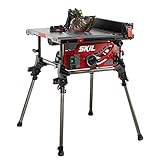
1. SKIL 15 Amp 10-Inch Jobsite Table Saw with Folding — Best overall
At 51.2 lb with legs that fold in, this is the only saw here light enough that a concrete floor stays usable for something else.
Best for: a small concrete-floored garage shop that doubles as parking Skip it if: you rip full sheets of plywood weekly
Weight is the whole argument. At 51.2 lb, the TS6307-00 is less than half the DEWALT's 110 lb and a fraction of the iron in either SawStop. On a slab, that difference decides whether the saw goes back against the wall after each session or stakes a permanent claim on the floor. SKIL says the legs fold in for storage and that rack-and-pinion rails keep the fence parallel to the blade, which is the same fence architecture the DEWALT and the Evolution use.
It's also the cheapest of the five, and it carries a 3 Year Limited Warranty, matching the longest coverage on the saw itself in this set. Cutting capacity is quoted as 4x4 at 90 degrees, with a bevel range of 2 to 47 degrees using positive stops at 0 and 45. Micro-adjustment for blade-to-fence alignment is listed, which matters more on a light saw that gets moved.
The trade-off against the rest of this set is rip capacity. SKIL doesn't publish a rip figure, and the DEWALT's stated 32-1/2 in is the number sheet-goods work actually needs.
Pros:
- Lightest saw here at 51.2 lb
- Cheapest of the five
- 3 Year Limited Warranty on the saw
- Folding stand frees the floor between sessions
- Rack and pinion fence rails
Cons:
- No published rip capacity figure
- Light body means less mass to damp vibration
- Dimensions listed as 1 x 1 x 1 in, so no packed size to plan around
- Sells faster than most here, but the stand is plastic-and-steel jobsite grade, not cast iron
2. Evolution R10TBLX 10" Jobsite Table Saw with Wheeled Stand — Best minimal setup
The only saw in this group whose maker claims mild steel and aluminium cutting, and the only one shipping with a dado plate.

Best for: cutting mild steel and aluminium alongside timber Skip it if: you need a published weight before you commit
Evolution's pitch is material range. The listing describes a high-torque 15A motor with soft start rated for wood, mild steel, aluminium and composites, supplied with a 10 in TCT blade. That's a claim, not a measurement, but nothing else in this set is even offered for metal. The dado plate is included too, so grooves and dadoes don't need a separate purchase.
The stated footprint of 15 x 29 x 29 in is the smallest published in this set by a wide margin, and the stand is described as collapsible with all-terrain wheels and a quick-fold system. On a rough or sloped slab, all-terrain casters do more good than the small hard wheels you usually get. Evolution also lists a zero-clearance throat plate, a rack and pinion fence, a cross-cut sled and an outfeed support bar as included, plus a 26 in rip and a 3-3/8 in depth of cut.
Against the SKIL, the gap is data. Evolution publishes no weight and the warranty appears only inside a feature bullet rather than as a stated spec, so you're buying on the listing's word.
Pros:
- Smallest published footprint at 15 x 29 x 29 in
- Dado plate and cross-cut sled included
- 26 in rip and 3-3/8 in cut depth stated
- All-terrain wheels suit an uneven slab
- Second-cheapest of the five
Cons:
- No published weight at all
- Warranty stated only in marketing copy, not as a spec
- Metal-cutting range is a manufacturer claim, unverified
- No bevel stop detail beyond 0-45°
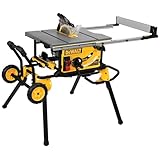
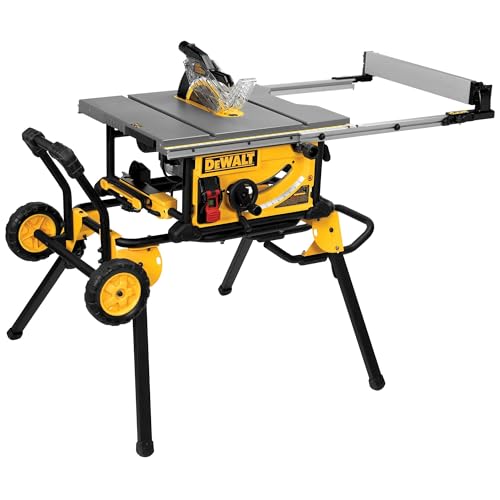
3. DEWALT Table Saw 10 Inch with Foldable Rolling Table Saw — Most versatile
A stated 32-1/2 in rip capacity puts full sheet goods within reach without the floor commitment of a cabinet saw.
Best for: site carpenters ripping wide shelving and trim Skip it if: you have to lift the saw up steps alone
The DWE7491RS is the compromise pick, and a good one. Its 32-1/2 in rip capacity is the widest published figure of the three portable saws here, and DEWALT ties it directly to cutting larger shelving and trim materials. The telescoping rails retract, so the wide capacity doesn't cost you standing room when the saw is parked.
At 110 lb it's more than twice the SKIL's 51.2 lb. That mass is a genuine benefit on concrete: more weight means less walk under load. It's also the reason the rolling stand matters. DEWALT describes it as designed for quick set-up and breakdown with the saw staying stable, which is the mechanism you're relying on every time the saw crosses a slab. Onboard storage is listed for the blade guard assembly, riving knife, fence, miter gauge, wrenches and push stick, and a patented material support is included for narrow rips.
Warranty is a 3 year limited manufacturer warranty, matching the SKIL. The cost of choosing it over the SKIL is mobility: 110 lb is a two-person lift into a truck bed, and it sits at the middle price position in this set.
Pros:
- Widest published rip at 32-1/2 in
- 4800 RPM and 15 Amp motor stated
- 110 lb mass resists walking on smooth concrete
- Onboard storage for guard, knife, fence and wrenches
- 3 year limited manufacturer warranty
Cons:
- 110 lb is a two-person lift
- Heaviest of the three portable saws here
- The slowest-moving of the three jobsite saws in this set
- Listed dimensions of 12.2 x 12.2 x 9.65 in don't describe the assembled saw
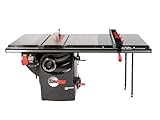
4. SawStop Professional 1.75HP Cabinet Saw with 36" — Best upgrade
The smaller of the two true cabinet saws, and the first pick here that justifies bolting something to your slab.
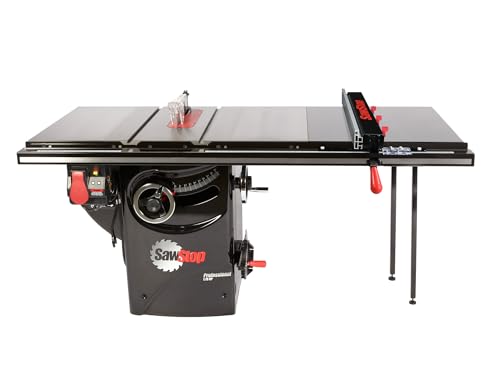
Best for: a permanent bay with 3 ft of clearance on each side Skip it if: the shop floor is shared with a car
This is where the search term earns its keep. A cabinet saw is a stationary machine, and a concrete floor is what makes one practical: level, load-bearing, and drillable for anchors. The PCS175-ATGP36 measures 34 x 69.1 x 31.1 in, with the listing separately quoting 69 1/8 in wide, 33 in deep and 34 in high. Either way, you're dedicating roughly six feet of wall length plus infeed and outfeed room around it.
The 1.75HP motor and the 36 in Professional T-Glide Advance Rip Fence are the headline pairing. SawStop describes the fence as delivering accuracy and ease of use unlike any other on the market, which is their claim to make, not mine. The safety system that stops the blade on contact with skin is the reason most buyers arrive at this brand at all.
Warranty is listed as 2 Years Saw, shorter than the 3-year coverage on both jobsite saws, which surprises people at this price position. The trade-off against the Industrial model is capacity: 36 in of fence against 52 in, and a 1.75HP single motor rather than 7.5HP.
Pros:
- Skin-contact blade stop system
- 36 in T-Glide Advance rip fence
- 1.75HP motor sized for standard shop wiring
- Smaller cabinet footprint than the Industrial at 69.1 in wide
Cons:
- 2 Years Saw warranty is the shortest here
- No published weight, so slab loading and moving are guesswork
- Immovable once positioned, unlike every other pick
- Most expensive pick here apart from the Industrial
5. SawStop Industrial 7.5HP, 3ph — Best premium
Almost 700 lb of iron and steel on a 230v three-phase supply, which is a building requirement as much as a purchase.

Best for: a commercial shop with 230v three-phase power Skip it if: you only have single-phase household circuits
The ICS73230-ATGI52 is the largest machine in this comparison at 34 x 85.5 x 36.5 in, and SawStop puts its mass at almost 700 lb of iron and steel. On a concrete slab that weight is an asset. On any other floor it's a structural question. The 52 in Industrial T-Glide Advance Rip Fence is the widest capacity here by 16 in over the Professional.
Two features separate it from the Professional beyond size. Dust collection runs above the table through the included blade guard and below it through shrouding around the blade, which is the kind of arrangement that keeps fine dust off a shop floor rather than in it. And an integrated Lock-Out Tag-Out switch restricts operation to authorised users, a shared-workshop feature rather than a home one.
Motor coverage is the best in this group at 5 Years Motor, though the saw itself is still 2 Years. The disqualifier for most readers is the supply: 7.5HP on 230v three phase is not something a garage circuit provides. This is the slowest seller of the five by a wide margin, which fits a machine aimed at commercial buyers.
Pros:
- 52 in rip fence, widest capacity here
- Dust collection above and below the table
- Lock-Out Tag-Out switch for shared shops
- 5 Years Motor coverage, longest in this set
- Almost 700 lb of iron for vibration control
Cons:
- Needs 230v three-phase power most homes lack
- Largest footprint at 85.5 in wide
- Saw warranty still only 2 years
- The most expensive pick here by a clear margin
What does a concrete floor actually change?
Three things, and none of them are about the blade.
Anchoring. A concrete slab is the only floor you can reliably bolt a cabinet base into. That's what makes either SawStop viable as a stationary machine and it's why heavy cabinet saws show up in slab-floored shops rather than upstairs workshops. Neither SawStop publishes a weight, but the Industrial's listing puts it at almost 700 lb of iron and steel, so the floor is doing real work.
Walking. Smooth sealed concrete is slippery under a light saw. The SKIL at 51.2 lb will shift under a hard rip if the stand isn't planted; the DEWALT at 110 lb is far less inclined to. Mass buys stability on a slick floor in a way that no feature bullet advertises.
Rolling distance. Rough or cracked slabs punish small hard casters. Evolution specifically claims all-terrain wheels on its collapsible stand, which is the one mobility detail in this set aimed at bad ground.
What a concrete floor does not do is make any of these saws suitable for cutting concrete. That job belongs to a different tool entirely.
Footprint math: will it fit your slab?
Measure before you shop. Here's the published data, largest first.
- SawStop Industrial: 34 x 85.5 x 36.5 in
- SawStop Professional: 34 x 69.1 x 31.1 in
- Evolution R10TBLX: 15 x 29 x 29 in
- DEWALT DWE7491RS and SKIL TS6307-00: no usable assembled dimensions published
For the two cabinet saws, add clearance. A 36 in rip fence needs at least 36 in of open table to the right of the blade, and a full sheet of plywood needs eight feet of infeed and outfeed room to travel through. That turns the Professional's 69.1 in width into a bay closer to 12 ft of usable length. The Industrial's 52 in fence and 85.5 in width push that further again.
The two folding saws sidestep the math. Evolution's 15 x 29 x 29 in is a folded figure small enough to park in a corner, and SKIL's folding legs achieve the same end without a published number. That flexibility is the single strongest argument for a jobsite saw on a shared slab, and it's why the SKIL leads this ranking rather than either cabinet machine.
Which saw wins when the job changes?
Three named conditions flip the recommendation, each easy to check before you buy.
If you rip sheet goods more than once a month, take the DEWALT over the SKIL. The 32-1/2 in stated rip capacity clears a half sheet of plywood. SKIL publishes no rip figure at all, and quotes cutting capacity as 4x4 at 90 degrees, which is a framing spec rather than a panel spec.
If any of your work is metal, take the Evolution. It's the only pick here whose maker claims mild steel, aluminium and composite cutting from a 15A soft-start motor. Nothing else in this group is offered for anything but wood.
If the slab is permanently yours and no car parks on it, take the SawStop Professional. A 1.75HP cabinet saw with a 36 in T-Glide fence and a skin-contact blade stop is a different class of machine from anything on folding legs. It only makes sense when the 34 x 69.1 x 31.1 in footprint plus clearance is space you'll never need back.
One more threshold worth naming: the SawStop Industrial's 230v three-phase requirement. If your panel can't supply it, the decision ends there regardless of budget.
What the listings do not tell you
Gaps in the published data are worth knowing before you commit.
Neither SawStop publishes a shipping weight. For a machine described as almost 700 lb of iron, that means delivery, unloading and positioning are all unknowns you'll need to resolve with the seller. Evolution publishes no weight either, which is odd for a saw sold on portability.
Dimension fields are unreliable on the two portable saws. SKIL lists 1 x 1 x 1 in and DEWALT lists 12.2 x 12.2 x 9.65 in, and neither describes an assembled 10 in table saw. Use rip capacity and weight as your planning figures instead.
Blade and accessory inclusions vary. Evolution states a 10 in TCT blade, zero-clearance plate, dado plate and cross-cut sled. DEWALT lists onboard storage for a guard assembly, riving knife, miter gauge and push stick. SKIL's bullets cover fence and bevel behaviour but name no included accessories. Nobody publishes a dust port size, which matters if you're plumbing a shop vac.
Finally, only one seller lists each of these five, so there's no alternative listing to compare specifications against.
The verdict
If your concrete floor does double duty as a parking space or a general work area, the best cabinet table saw for concrete in this set is the SKIL TS6307-00. At 51.2 lb with folding legs, a 3 Year Limited Warranty and rack-and-pinion fence rails, it gives up the least floor space of anything here and costs the least. It's the sensible default for a garage shop.
If the slab is a dedicated shop bay, buy the SawStop Professional PCS175-ATGP36 instead. Its 34 x 69.1 x 31.1 in cabinet, 1.75HP motor, 36 in T-Glide Advance fence and skin-contact blade stop are what a permanent slab exists to support, and no folding saw closes that gap.
The cutoff between those two tracks is simple: whether the space in front of the saw is yours seven days a week. If it is, the cabinet saw wins on capacity, mass and safety hardware. If it isn't, the folding saw wins on the only axis that matters, which is being able to disappear.
The DEWALT's exact advantage over the SKIL is its stated 32-1/2 in rip capacity, and it's the pick if half sheets of plywood are routine work rather than an occasional job.
FAQ
Is a cabinet table saw worth it on a garage slab?
A cabinet table saw is worth it on a garage slab only when the space is permanently yours. The SawStop Professional's 34 x 69.1 x 31.1 in footprint plus infeed and outfeed clearance needs roughly 12 ft of usable bay length. If a car parks there nightly, the SKIL's folding stand and 51.2 lb weight serve you far better.
Can the best cabinet table saw for concrete actually cut concrete?
No. Searches for the best cabinet table saw for concrete usually mean a saw for a concrete-floored shop, not a masonry cutter. Every saw here is a woodworking table saw with a 10 in blade, and the Evolution is the only one claiming metal capability. Cutting concrete, slabs or block requires a cut-off saw or wet tile saw with a diamond blade.
Which is better, the SKIL TS6307-00 or the DEWALT DWE7491RS?
Between the SKIL TS6307-00 and the DEWALT DWE7491RS, the split is weight against capacity. The SKIL is 51.2 lb and folds flat, so it's the better choice on a shared floor. The DEWALT is 110 lb with a stated 32-1/2 in rip capacity and 4800 RPM, so it's the better choice for sheet goods. Both carry 3-year warranties.
What power supply does the SawStop Industrial need?
The power supply the SawStop Industrial needs is 230v three-phase, driving a 7.5HP motor. Most homes and many small shops have single-phase service only, which rules this saw out before budget enters the discussion. Check your panel first. The 1.75HP SawStop Professional is the practical alternative for a shop without three-phase wiring available.
What mistake do first-time table saw buyers make?
The mistake first-time table saw buyers make is choosing rip capacity over footprint. Rip capacity you can work around with an outfeed table and a helper. Floor space you cannot. A 52 in fence on an 85.5 in wide cabinet demands a bay you may never get back, while a folding stand keeps the slab available for everything else.
Start with the measurement, not the model. Chalk the footprint on your slab, add the infeed and outfeed room a full sheet needs, then see what's left. If the outline swallows the whole bay, the SKIL TS6307-00 is the honest answer: 51.2 lb, folding legs, a 3-year warranty and the cheapest entry in this group, on a floor you keep. Buyers who genuinely own their shop bay outright should jump straight to the SawStop Professional and stop compromising on fence quality. Either way, the floor decides first and the blade decides second.