Best Cordless Circular Saw for Contractors: DEWALT Leads

Six cordless circular saws ranked for jobsite work, from DEWALT's 7-1/4 in. brushless winner to a compact budget RYOBI. Real specs, honest trade-offs, and the one thing most buyers get wrong about blade size.

By Sidney GrayUpdated 16 min read
On this page
- Best cordless circular saw for contractors at a glance
- Why blade size decides this more than voltage
- How I ranked six saws on published specs alone
- 1. DEWALT 20V MAX XR Brushless Cordless 7-1/4 in. Circular — Best overall
- 2. DEWALT FLEXVOLT 60V MAX Circular Saw Kit — Best premium
- 3. SEESII Brushless Cordless Circular Saw — Best for families
- 4. Extbtfor Cordless Circular Saw — Best for heavy use
- 5. DEKOPRO 20V Cordless Circular Saw — Best for beginners
- 6. RYOBI ONE+ 18V Cordless 5-1/2 in. Circular Saw — Best budget pick
- What separates a jobsite saw from a mini saw?
- Does a bigger battery platform matter for contractors?
- When does a smaller saw actually win?
- The verdict
- FAQ
The best cordless circular saw for contractors is the DEWALT 20V MAX XR DCS590B, a 7-1/4 in. brushless saw that cuts 2-9/16 in. deep at 90° and spins up to 5,500 RPM. If you want the deepest bevel and a battery in the box, the FLEXVOLT DCS577X1 kit is the better buy, with a 53° bevel and a 9.0Ah cell. Both take full-size blades. The 30-second shortlist below sorts the field by who you are and what you cut.
Best cordless circular saw for contractors at a glance
| Pick | Blade size | Cut depth at 90° | Price |
|---|---|---|---|
Best overall DEWALT 20V MAX XR DCS590B |
7-1/4 in. | 2-9/16 in. | Check Price |
Best premium DEWALT FLEXVOLT 60V DCS577X1 |
7-1/4 in. | 2-7/16 in. | Check Price |
Best for families SEESII Brushless CS03 |
4-1/2 in. | not listed | Check Price |
Best for heavy use Extbtfor Cordless Saw |
4-1/2 in. | 1-11/16 in. | Check Price |
Best for beginners DEKOPRO 20V Cordless |
6-1/2 in. | not listed | Check Price |
Best budget pick RYOBI ONE+ 18V PCL500B |
5-1/2 in. | not listed | Check Price |


Why blade size decides this more than voltage
Most guides lead with voltage. Buyers see 60V and assume it beats 20V. That is the wrong first question. Voltage tells you about the platform, not about what the saw can actually cut in one pass.
Blade size decides depth of cut. A 7-1/4 in. blade is the standard for framing and sheet goods because it clears a 2x in one pass at 90°. A 4-1/2 in. blade cannot. It is a different tool wearing the same name.
Here is the split in this field. Two saws take a 7-1/4 in. blade: the DEWALT DCS590B at 2-9/16 in. depth, and the FLEXVOLT DCS577X1 at 2-7/16 in. Both clear a 2x. The DEKOPRO runs a 6-1/2 in. blade. The RYOBI runs 5-1/2 in. The SEESII and Extbtfor list 4-1/2 in. blades, and the Extbtfor tops out at 1-11/16 in. deep at 90°.
That last figure matters. A framing 2x is 1-1/2 in. thick, so a 1-11/16 in. saw clears it barely. Cut on an angle and you run out of depth. The best cordless circular saw for contractors, in practice, is the one whose blade matches the material you cut every day.
How I ranked six saws on published specs alone
I compared the published specifications side by side, and three things knocked saws down the list before anything else did.
First, cut depth that fails framing. A saw that cannot clear a 2x at a bevel is a trim tool, and I ranked it as one. Second, a thin spec sheet. When a listing skips depth of cut, motor speed, or warranty, I can't verify the claims a contractor cares about, so it drops. Third, a tiny blade paired with a jobsite pitch. Several here are marketed for worksite use but built around a 4-1/2 in. blade.
What survived sorts cleanly:
- Full-size blade, deep cut: the two DEWALT saws
- Mid-size blade, mixed use: the DEKOPRO 6-1/2 in. and RYOBI 5-1/2 in.
- Compact blade, light-duty: the SEESII and Extbtfor at 4-1/2 in.
I did not weight brand name. I weighted whether the published numbers back up the jobsite claim. The DEWALT pair wins because 7-1/4 in. and a stated 2-9/16 in. depth are exactly what the work needs, and both are on the page in writing.
1. DEWALT 20V MAX XR Brushless Cordless 7-1/4 in. Circular — Best overall
The DCS590B is the pick for contractors because it pairs a full 7-1/4 in. blade with a 2-9/16 in. cut at 90°, the deepest verified cut in this field.
Best for: framing and full-sheet crews who need real depth of cut Skip it if: you only make shallow trim cuts
What sets this saw apart in the group is a matched pair of published numbers a contractor can act on. It cuts 2-9/16 in. deep at 90° and 2 in. at 45°, so a 2x clears in one pass even on a bevel. DEWALT rates the brushless motor at up to 5,500 RPM no-load and calls it their most powerful 20V MAX circular saw, with up to 1,700 MWO. Those last two are the manufacturer's claims, not my measurements, but the depth figures are the ones that matter and they hold up.
At 9.15 lb, it is lighter than the FLEXVOLT kit's 10.9 lb, which counts across a shift of overhead cuts. It carries an electric brake DEWALT says stops the blade after you release the trigger. The model is DCS590B, and it ships as a bare tool, so it slots into an existing 20V MAX kit without a spare battery you don't need.
The trade-off is real. This is the tool-only listing, so there's no battery or charger in the box, and it sits at the second-highest price position here. If you're not already on the platform, budget for a cell.
Pros:
- Deepest verified cut in the set at 2-9/16 in.
- Full 7-1/4 in. blade clears a 2x on bevel
- Lightest of the two full-size saws at 9.15 lb
- Electric brake stops the blade after release
- Slots into existing 20V MAX kits
Cons:
- Bare tool only, no battery or charger
- Second-highest price position in the set
- No published warranty on the listing
2. DEWALT FLEXVOLT 60V MAX Circular Saw Kit — Best premium
The DCS577X1 is the deepest-bevel saw here, with a 53° tilt and a 9.0Ah battery in the box, for crews who want to buy once.

Best for: crews wanting the deepest bevel and a kit that ships with a battery Skip it if: you want the lightest saw in your bag
This is the only pick that arrives ready to cut. It's a kit with a 9.0Ah battery, so there's no separate purchase to plan. It's also the only saw here with a stated warranty, a 3 year limited warranty, which is a real edge for a tool that lives in a truck. DEWALT lists a worm-style, left-blade layout with the handle at the rear for line of sight, plus a magnesium shoe.
On bevel it goes furthest. DEWALT lists a 53° bevel capacity with stops at 45° and 22.5°, past the DCS590B. At 90° it cuts 2-7/16 in. deep, a touch shy of the DCS590B's 2-9/16 in. but still clearing a 2x with room. It carries the same electronic brake DEWALT describes across its cordless saws.
Two things pull it below the overall winner. At 10.9 lb it's the heaviest saw here, and that adds up on repetitive overhead work. It also sits at the top price position of the six. You're paying for the 60V platform, the battery, and the warranty. If your work needs a 53° bevel and you want a saw that runs out of the box, that spend is justified.
Pros:
- Only saw here with a stated warranty, 3 years
- Deepest bevel in the set at 53°
- Ships with a 9.0Ah battery and charger
- Magnesium shoe and left-blade line of sight
Cons:
- Heaviest saw in the group at 10.9 lb
- Highest price position of the six
- Shallower at 90° than the DCS590B
3. SEESII Brushless Cordless Circular Saw — Best for families
The SEESII CS03 ships with two 4.0Ah batteries and a three-blade kit, making it a share-around shop saw rather than a framing tool.

Best for: shared-shop use where two batteries ship in the box Skip it if: you cut framing lumber at full depth all day
What makes this one useful in a home shop is the box contents. It comes with two 4.0Ah batteries, so one charges while the other cuts. SEESII says the brushless motor reaches up to 6,500 RPM, the highest claimed speed in this field. That's the manufacturer's figure, not a measured one, but it points to a saw meant for quick, repeat cuts rather than deep passes.
The blade is where it lands as a family tool, not a jobsite one. It's a 4-1/2 in. saw, and the listing doesn't state depth of cut at 90°, so I can't promise it clears a 2x. It offers a 0–45° bevel and includes three blades, TCT, HSS, and diamond, so it handles wood, soft metal, and tile-type materials in one tool. There's a laser guide and a guide rail for straighter cuts.
At 10 lb it's heavy for a compact saw, and that's the honest catch. You get twin batteries and a multi-material kit, but not the depth a contractor needs for framing. As a shared saw for trim, panels, and light DIY, it earns its place.
Pros:
- Two 4.0Ah batteries in the box
- Three-blade kit for multi-material cutting
- Highest claimed speed here at 6,500 RPM
- Laser guide and guide rail included
Cons:
- No published depth of cut at 90°
- Small 4-1/2 in. blade, not for framing
- Heavy for its class at 10 lb
4. Extbtfor Cordless Circular Saw — Best for heavy use
The Extbtfor is a one-handed mini saw with a stated 4 lb weight and a 13-piece kit, built for volume trim work rather than depth.
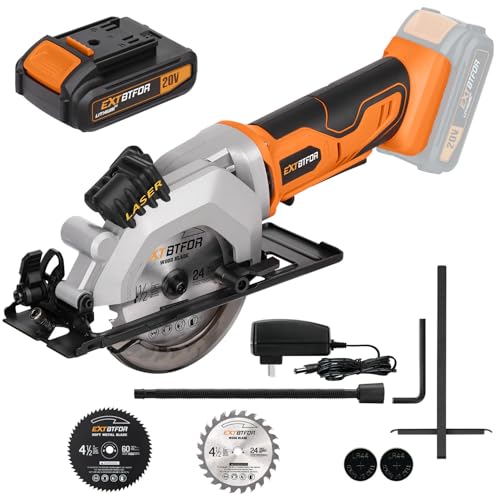
Best for: one-handed trim and panel work with multiple included blades Skip it if: you need to cross-cut 2x framing stock
This is the lightest saw in the set by a wide margin. Extbtfor lists a 4 lb weight and says you can lift and cut with one hand, which is why it lands here for sustained repeat work where fatigue is the enemy. The count of 13 in the listing reflects a full accessory kit: it ships with an HSS blade, a TCT blade, a charger, a 2.0Ah battery, a guide ruler, and a dust pipe.
The numbers set expectations honestly. It's a 4-1/2 in. saw with a stated 1-11/16 in. cut depth at 90° and 1-1/8 in. at 45°. That clears a 1-1/2 in. framing 2x flat, barely, and runs short of depth on a bevel. Extbtfor lists a 3,400 RPM no-load speed and a laser guide.
The limits are the same as any mini saw. Depth is tight, the 2.0Ah battery is small, and it won't replace a full-size saw for structural cuts. But for cutting down plywood, trim, and thin stock at speed all day, a 4 lb saw you can run one-handed is genuinely less tiring. That's the trade it makes against the DEWALT pair.
Pros:
- Lightest saw here at a stated 4 lb
- One-handed operation for repeat cuts
- 13-piece kit with HSS and TCT blades
- Includes guide ruler and dust pipe
Cons:
- Shallowest cut in the set at 1-11/16 in.
- Small 2.0Ah battery limits runtime
- Runs short of depth on bevel cuts
5. DEKOPRO 20V Cordless Circular Saw — Best for beginners
The DEKOPRO pairs a 6-1/2 in. blade with two 4.0Ah batteries and a laser guide, giving new users a bigger blade and a full starter kit.

Best for: new users wanting two batteries and a laser guide out of the box Skip it if: you already own a major battery platform
For someone starting out, this saw carries the most useful blade of the sub-full-size group. It's a 6-1/2 in. carbide-tipped blade, larger than the RYOBI's 5-1/2 in. and both 4-1/2 in. picks, so it handles hardwood and softwood with more depth to give. DEKOPRO lists a 4,500 RPM no-load speed and ships two 4.0Ah batteries and a charger, so there's nothing else to buy on day one.
It's built to guide a first-timer. There's a 0–45° adjustable bevel and a laser that projects a cut line, which DEKOPRO says improves visibility. The model is DKCS20Q1Y-G, and it weighs 9.46 lb.
Where it lands short is the spec sheet. The listing doesn't publish a depth of cut at 90°, so I can't tell you whether it clears a 2x, and the dimensions read oddly for a saw at 5.91 in. cubed. For a beginner who wants a complete kit and a mid-size blade to learn on, it's a sensible first buy. For a contractor already invested in a battery system, the bare-tool DEWALT makes more sense than a fresh platform. That's the trade-off against the winner.
Pros:
- Larger 6-1/2 in. blade than most non-full-size picks
- Two 4.0Ah batteries and charger included
- Laser guide for cut-line visibility
- 0–45° adjustable bevel for angled cuts
Cons:
- No published depth of cut at 90°
- Adds a new battery platform to your kit
- Listed dimensions are hard to read
6. RYOBI ONE+ 18V Cordless 5-1/2 in. Circular Saw — Best budget pick
The RYOBI PCL500B is the cheapest here and a smart add-on if you already run ONE+ batteries, though it's a bare tool with a short warranty.

Best for: adding a compact saw to an existing RYOBI ONE+ kit Skip it if: you want a full-size blade or a long warranty
The value here is entirely about the platform. If you're already on RYOBI ONE+ 18V, this is the cheapest way to add a compact circular saw to the batteries you own. It's a 5-1/2 in. blade, which sits between the mini saws and the mid-size DEKOPRO. The model is PCL500B, in the familiar green, and it's sold as a bare tool.
There's not much else on the page to work with. The listing publishes no depth of cut, no motor speed, and no weight, so I can't tell you how deep it cuts or how fast it spins. The dimensions read as accessory-sized rather than saw-sized, and one feature line references replacement lawn parts, which looks like a listing error rather than anything about the saw.
Two things count against it beyond the thin data. The warranty listed is 30 days, the shortest in this field by far, against the FLEXVOLT's 3 years. And a 5-1/2 in. blade won't clear a 2x the way the DEWALT pair does. As a light second saw for an existing ONE+ user, the low price position earns it a spot. For a main jobsite saw, it isn't one.
Pros:
- Cheapest of the six
- Slots into existing RYOBI ONE+ batteries
- Compact 5-1/2 in. blade for tight work
- Familiar, widely stocked platform
Cons:
- Shortest warranty here at 30 days
- No published depth, speed, or weight
- Bare tool with a very thin spec sheet
What separates a jobsite saw from a mini saw?
The line runs through blade size and cut depth, not price or color. A jobsite saw clears a framing 2x and a full sheet of plywood in one clean pass. A mini saw is a trim and panel tool that happens to look similar.
Here's how to read a listing before you buy:
- Find the blade diameter. 7-1/4 in. is the framing standard. Anything under 6 in. is a light-duty saw.
- Find the depth of cut at 90°. You want more than 2 in. to clear a 2x with margin. The DCS590B lists 2-9/16 in.
- Check the depth at 45°. Bevel cuts eat depth. The DCS590B still gives 2 in. here; the Extbtfor drops to 1-1/8 in.
- Look for an electric brake. Both DEWALT saws list one, which stops the blade fast after you release the trigger.
Run those four checks and the field sorts itself. The two DEWALT saws pass all four. The mini saws pass the brake test rarely and the depth test never. If a listing hides depth of cut, treat that as a warning, not an oversight.
Does a bigger battery platform matter for contractors?
A bigger battery platform matters mostly for the tools you already own, not for the saw alone. The value is in sharing cells across a driver, an impact, and a saw, so you charge one system instead of three.
- 20V MAX (DCS590B): wide tool lineup, and the bare-tool price assumes you own cells.
- 60V FLEXVOLT (DCS577X1): more headroom, ships with a 9.0Ah battery, and back-compatible with the same brand's 20V tools.
- 18V RYOBI ONE+ (PCL500B): huge, affordable lineup for an owner already in the system.
- Proprietary (DEKOPRO, SEESII, Extbtfor): batteries stay with that one tool, so a spare is a dedicated buy.
For a contractor, the platform decision usually outlasts the saw. Buying a bare tool on a system you already run, like the DCS590B, is cheaper in the long run than a standalone kit that traps its batteries. The exception is a first tool with no platform yet, where a kit that ships with cells removes a purchase.
When does a smaller saw actually win?
A smaller saw wins when depth is not the job. Plenty of a contractor's day is trim, plywood breakdown, and light stock, and a 9 lb full-size saw is overkill for that. Weight and one-handed control start to matter more than raw depth.
- If you cut framing lumber all day, the DCS590B wins on depth, full stop.
- If you break down sheets and cut trim, the 4 lb Extbtfor is far less tiring over hours.
- If a shop tool gets shared, the SEESII's two batteries and three-blade kit cover mixed jobs.
- If you're new and want one kit, the DEKOPRO's 6-1/2 in. blade splits the difference.
The threshold is simple. Above a 1-1/2 in. cut depth need, buy full-size. Below it, a lighter saw does the work with less fatigue. Most contractors own both eventually, a 7-1/4 in. saw for structure and a mini saw for repetitive light cuts.
The verdict
If you cut framing and full sheets, the DEWALT DCS590B is the best cordless circular saw for contractors. Its 2-9/16 in. cut at 90° is the deepest verified figure here, it takes a full 7-1/4 in. blade, and at 9.15 lb it's lighter than the only other full-size saw in the group. The cutoff is depth of cut: a saw that can't clear a 2x on a bevel isn't a framing tool.
If you want the deepest bevel and a saw that runs out of the box, the FLEXVOLT DCS577X1 is the better buy. It tilts to 53°, ships with a 9.0Ah battery, and carries the only stated warranty here, 3 years. Its exact advantage over the winner is that completeness and the wider bevel, paid for with a heavier 10.9 lb body and the top price position.
Below those two, the field is trim and light-duty. The DEKOPRO's 6-1/2 in. blade leads the smaller saws, the SEESII suits shared shop use, and the Extbtfor's 4 lb build wins on fatigue. The RYOBI makes sense only as a cheap add-on for an existing ONE+ owner. For most contractors, start with the DCS590B.
FAQ
Is the best cordless circular saw for contractors worth the premium?
The best cordless circular saw for a working crew is worth the premium when depth of cut earns its keep. The DCS590B's 2-9/16 in. cut at 90° clears a 2x on a bevel, which the mini saws can't. If you frame or cut sheet goods daily, paying up for a full 7-1/4 in. saw pays back in fewer passes and cleaner cuts.
Is a 60V saw worth it over a 20V one for a contractor?
A 60V saw is worth it over a 20V one when you want the deepest bevel and a battery in the box. The FLEXVOLT DCS577X1 tilts to 53° and ships with a 9.0Ah cell and a 3 year warranty. But the 20V DCS590B cuts deeper at 90°, 2-9/16 in. versus 2-7/16 in., and weighs less. Voltage isn't the deciding number here.
What depth of cut do I need to cut framing 2x lumber?
The depth of cut you need for framing 2x lumber is more than 1-1/2 in. at your working angle, since a 2x is 1-1/2 in. thick. The DCS590B lists 2-9/16 in. at 90° and 2 in. at 45°, so it clears with margin. The Extbtfor's 1-11/16 in. at 90° barely clears flat and falls short on a bevel.
DCS590B or DCS577X1: which DEWALT should a contractor buy?
Between the DCS590B and DCS577X1, choose by weight and bevel. The DCS590B cuts deeper at 90°, 2-9/16 in., and weighs 9.15 lb, so it wins for all-day framing. The DCS577X1 tilts to 53°, ships with a battery, and carries a 3 year warranty, but at 10.9 lb it's heavier. Buy the 590B if you own 20V cells; buy the 577X1 for a complete kit.
What mistake do buyers make choosing a cordless circular saw?
The mistake buyers make choosing a cordless circular saw is treating blade size as a detail. A 4-1/2 in. saw marketed for the jobsite still can't clear a 2x at a bevel, no matter how it's described. Check the published depth of cut at 90° and 45° before you buy. If a listing hides that number, assume it can't do framing work.
Pick the saw that matches the cut you make most. If that's framing and full sheets, the DEWALT DCS590B is the default: a full 7-1/4 in. blade, 2-9/16 in. of depth at 90°, and an electric brake, at a lighter 9.15 lb than the only other full-size option here. Own a battery platform already? A bare tool is the cheaper long-term move than a fresh kit that locks its cells to one saw. Check the depth of cut, confirm the platform, then buy once and cut for years.