Best Cordless Circular Saw for Fine Woodworking

Five cordless circular saws lined up against the demands of real woodworking, with a clear winner, a runner-up for framing depth, and honest picks for lighter jobs.

By Sidney GrayUpdated 14 min read
On this page
- Who this is not for
- Best cordless circular saw for woodworking at a glance
- How I screened five listings against woodworking demands
- Blade size decides more than motor power
- Full-size or mini: which body suits your bench?
- 1. Makita XSS02Z 18V LXT 6-1/2 in. — Best overall
- 2. DEWALT DCS590B 20V MAX XR 7-1/4 in. — Best premium
- 3. WORKPRO 20V 4-1/2 in. Cordless Mini — Best for heavy use
- 4. SEESII Brushless 4-1/2 in. — Best for families
- 5. Extbtfor 4-1/2 in. Cordless — Best budget pick
- What the listings do not tell you
- How to judge a cordless saw I did not cover
- The verdict
- FAQ
The best cordless circular saw for woodworking is the Makita XSS02Z, a 6-1/2 in. bare tool that delivers 2-1/4 in. of cut at 90°, weighs 3.31 lb without a battery, and rides on a precision-machined aluminium base. Step up to the DEWALT DCS590B when you need a full 7-1/4 in. blade and 2-9/16 in. of depth for thicker stock or bevelled joinery in construction lumber.
Who this is not for
Woodworking covers everything from dovetailed drawers to deck framing, and no single cordless saw is right for all of it. If you cut mostly plywood, hardwood boards under 2 in. thick, and softwood for shop jigs, keep reading. If you rip green 4x lumber all day, or you break down full sheets on sawhorses every week, you want a corded track saw or a table saw, not a battery tool. And if your idea of woodworking is scroll-cut inlay or thin veneer, a jigsaw or a bandsaw will serve you better. The best cordless circular saw for woodworking earns its place between those extremes: portable enough to move around a project, precise enough for cabinet-grade cuts.
One more note. Two of the five saws here are branded "mini" and cap out at 1-11/16 in. of depth. That is enough for 3/4 in. plywood twice over, but it will not clear a nominal 2x4 laid flat. Match the saw to the thickest stock you actually cut.
Best cordless circular saw for woodworking at a glance
| Pick | Blade & depth at 90° | Weight | Price |
|---|---|---|---|
Best overall Makita XSS02Z 18V LXT 6-1/2 in. |
6-1/2 in. 2-1/4 in. |
3.31 lb (bare) | Check Price |
Best premium DEWALT DCS590B 20V MAX XR 7-1/4 in. |
7-1/4 in. 2-9/16 in. |
9.15 lb | Check Price |
Best for heavy use WORKPRO 20V 4-1/2 in. Mini |
4-1/2 in. 1-11/16 in. |
9.59 lb (kit) | Check Price |
Best for families SEESII Brushless 4-1/2 in. |
4-1/2 in. depth not listed |
10 lb (kit) | Check Price |
Best budget pick Extbtfor 4-1/2 in. Cordless |
4-1/2 in. 1-11/16 in. |
not listed | Check Price |


How I screened five listings against woodworking demands
I lined up five cordless circular saws from the same category and compared the published specifications field by field: blade diameter, cutting depth at 90° and 45°, bare weight, motor speed, bevel range, and whether a battery ships in the box. Then I asked one question of each spec sheet: can this saw cut a nominal 2x4 in a single pass? Only two of the five say yes on paper. The Makita XSS02Z clears 2-1/4 in. at 90°, and the DEWALT DCS590B clears 2-9/16 in. The other three cap at 1-11/16 in., which puts them in the trim-and-plywood category rather than the general-woodworking category.
The other thing I checked was base quality, because a saw wanders when its shoe flexes. Makita lists a precision-machined aluminium base on the XSS02Z. None of the other four listings describe their base material at that level of detail. That is not proof the others are worse, but on a spec sheet it is the difference between a stated engineering feature and a blank.
Blade size decides more than motor power
Most cordless-saw comparisons chase RPM figures. That is not what decides it. Cutting depth is. A saw that spins fast but tops out at 1-11/16 in. cannot cut a 2x, no matter how many amps its battery delivers. Blade diameter sets the ceiling, and everything downstream of that is a question of finish and speed.
Here is the practical hierarchy for a woodworker:
- Depth at 90° must clear your thickest stock in one pass.
- Bevel range must cover the joinery angles you cut.
- Base flatness and reference edge decide accuracy.
- Battery and motor decide runtime and how the saw sounds under load.
Apply that filter to this set and the field halves. The Makita and the DEWALT clear structural lumber. The three 4-1/2 in. mini saws are trim tools, useful for plywood breakdown and small parts but not for framing.
Full-size or mini: which body suits your bench?
The five saws split cleanly into two body classes. Two are full-size: the 6-1/2 in. Makita and the 7-1/4 in. DEWALT. Three are minis with 4-1/2 in. blades: the WORKPRO, the SEESII and the Extbtfor. That split is more important than the brand names.
- Full-size saws cut structural lumber, sheet stock stacked two deep, and thick hardwood slabs.
- Mini saws cut plywood, MDF, hardboard, trim, and softwood up to a nominal one-by.
- The Makita XSS02Z is the lightest saw here at 3.31 lb bare, lighter than any of the minis in kit form.
- The DEWALT is the heaviest full-size option at 9.15 lb, which is the price of a 7-1/4 in. blade.
- The mini kits ship at 9.59 lb and 10 lb, because most of that weight is battery.
If your bench work is fine woodworking under 2 in. thick, the choice is not full-size versus mini. It is which full-size saw balances best in your hand for one-handed cross-cuts, and the Makita's bare weight is unusual in this set.
1. Makita XSS02Z 18V LXT 6-1/2 in. — Best overall
A 3.31 lb bare tool with a 2-1/4 in. depth of cut and a machined aluminium base, which is the combination cabinet work actually rewards.
Best for: furniture makers cutting 3/4 in. hardwood and sheet goods on a bench Skip it if: you need to rip a full 2x on edge in one pass
The XSS02Z is the only saw in this set that pairs a serious blade size with a bare weight measured in the low threes. At 3.31 lb without a battery, and 7.3 lb with one according to Makita's listing, it is genuinely one-handable for cross-cuts on plywood and hardwood. The 2-1/4 in. depth at 90° clears every common cabinet stock, doubled 3/4 in. plywood, and a 2x laid flat. Makita states a bevel range of 0 to 50°, which is wider than the 0 to 45° of most saws here and useful when you cut backing angles on face frames. Makita also puts a machined aluminium base under the blade, the only base description in this set that specifies the material and process. The saw is bare tool only, so you buy into the 18V LXT battery platform separately. That is the right choice if you already own Makita cordless tools, and it is the reason this pick sits at a premium price position for what looks on the shelf like a smaller saw.
Pros:
- 6-1/2 in. blade with 2-1/4 in. depth at 90°
- Machined aluminium base for a flat reference
- 0 to 50° bevel range, wider than most here
- 3.31 lb bare, the lightest saw in this set
- 3-year limited warranty, the longest published here
Cons:
- Bare tool only, no battery or charger in the box
- Premium price position for a 6-1/2 in. saw
- Locked to the Makita 18V LXT battery platform
2. DEWALT DCS590B 20V MAX XR 7-1/4 in. — Best premium
A full 7-1/4 in. blade with 2-9/16 in. of depth and a brushless motor rated at 5,500 RPM, for the woodworker who also frames.

Best for: someone crossing between framing and cabinet work with one saw Skip it if: your bench work is all under 2 in. thick and you value light weight
The DCS590B is the only saw here with a 7-1/4 in. blade, which is the standard construction size, and its 2-9/16 in. depth at 90° clears a doubled 2x with room to spare. DEWALT rates the brushless motor at up to 5,500 RPM no-load and quotes up to 368 cuts per charge, which is a manufacturer figure and depends on the pack and the stock. The listing also describes an electric brake designed to stop the blade after the trigger releases, which matters for repeat cross-cuts where a coasting blade nicks the workpiece. At 9.15 lb bare, it is nearly three times the weight of the Makita, and that shows up in your shoulder by the end of a long session. This is the saw for the woodworker whose projects sometimes include a deck, a shed, or a workshop wall. It gives up compactness for depth and power, and the trade-off is fair.
Pros:
- 7-1/4 in. blade with 2-9/16 in. depth at 90°
- Brushless motor rated at up to 5,500 RPM by DEWALT
- Electric brake to stop blade coasting
- Fits the wide DEWALT 20V MAX battery platform
Cons:
- 9.15 lb, heaviest full-size saw in this set
- Highest price position of the five
- Bare tool, no battery or charger included
- No published warranty in the listing data
3. WORKPRO 20V 4-1/2 in. Cordless Mini — Best for heavy use
A mini saw that ships with a 4.0Ah battery, two wood-specific blades and a 2-year manufacturer warranty.

Best for: hobby woodworkers who want a battery kit included for a mini saw Skip it if: you plan to cut anything thicker than 1-11/16 in.
Among the three 4-1/2 in. minis here, the WORKPRO is the one built for repeat use. WORKPRO says the kit ships with a 24T alloy wood blade, a 60T blade for wood and plastic, a diamond blade, a 4.0Ah battery pack and a fast charger. The saw offers 1-11/16 in. of cut at 90° and 1-1/8 in. at 45°, which covers 3/4 in. plywood twice, most trim stock, and light hardwood. WORKPRO rates the motor at 4,500 RPM. What sets this pick apart in the mini class is the published 2-year manufacturer warranty and the 4.0Ah battery, which is a step up from the 2.0Ah pack in the entry option. At 9.59 lb for the kit, this is not a pocket tool, and depth is capped by the 4-1/2 in. blade. But for a woodworker who wants one battery, a real blade set and a paper warranty, it earns the pick.
Pros:
- 4.0Ah battery and fast charger included in kit
- Two wood-appropriate blades in the box
- 2-year manufacturer warranty on the listing
- Bevel range 0 to 45° for common joinery
Cons:
- 1-11/16 in. max depth caps stock thickness
- Not on a major cordless battery platform
- 9.59 lb kit weight is heavy for a mini
4. SEESII Brushless 4-1/2 in. — Best for families
Two 4.0Ah batteries in the box and a brushless motor, for shared use on trim and craft projects.

Best for: shared household use on plywood, trim and light craft stock Skip it if: you want a compact saw and a light kit
SEESII pairs a brushless motor, which it rates at up to 6,500 RPM, with two 4.0Ah batteries in the same kit. For a household where more than one person picks up the saw, twin batteries mean a fresh pack is always charged. SEESII also lists a laser guide and a guide rail system, plus a three-blade set that covers wood, metal and masonry with TCT, HSS and diamond blades. Cutting depth is not stated in the listing data supplied, which is a real gap for a woodworking buyer: without a published depth figure I cannot promise a specific stock thickness. What is clear is the 4-1/2 in. blade size, which puts it in the same trim-and-plywood class as the WORKPRO and the Extbtfor. At 10 lb the kit is the heaviest of the three minis, and the second-cheapest saw in this set. Treat this as a light-duty family tool rather than a bench-woodworking primary.
Pros:
- Brushless motor rated at up to 6,500 RPM by SEESII
- Two 4.0Ah batteries included in the kit
- Laser guide and guide rail listed
- Three-blade set covers common materials
Cons:
- Cutting depth not stated in the listing
- 10 lb kit weight, heaviest mini here
- Not on a major cordless battery platform
- No published warranty in the listing data
5. Extbtfor 4-1/2 in. Cordless — Best budget pick
The cheapest saw here, with a 2.0Ah battery, three blades and a stated depth of 1-11/16 in.
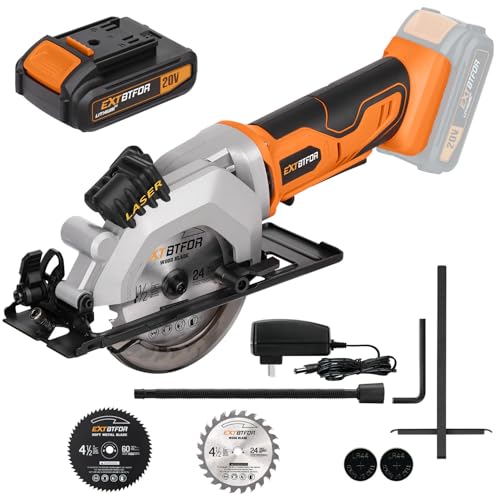
Best for: occasional trim, plywood and small project cuts Skip it if: you want a stated warranty or a brushless motor
The Extbtfor is the cheapest of the five and the cheapest way into a cordless circular saw for a woodworker who cuts once a month. Extbtfor states 1-11/16 in. of cut at 90° and 1-1/8 in. at 45°, a 20V 2.0Ah battery pack, and a package that includes an HSS blade, a TCT blade, a guide ruler, an Allen wrench and a dust pipe. Extbtfor also describes the saw as 4 lb in the body, which is light for one-handed work on plywood. The listing does not publish a warranty and does not describe the motor as brushless. Depth is capped like the other minis. This is the pick when the alternative to buying a saw is not buying one at all, and when the projects on the horizon are picture frames, small boxes, and shelf boards rather than furniture. It punches at its price position, which is where you should judge it.
Pros:
- Cheapest of the five picks here
- Three blades and a guide ruler included
- Light body claimed at 4 lb by Extbtfor
- Laser guide on the listing
Cons:
- 2.0Ah battery, smallest in this set
- No published warranty in the listing data
- Motor not described as brushless
- 1-11/16 in. max depth caps stock thickness
What the listings do not tell you
Amazon listings are shaped to sell, not to specify. Three things you will not see in the bullet points, and should know before you commit:
- Runtime is a moving target. DEWALT's "up to 368 cuts per charge" figure applies to a specific battery and stock. Change either and the number changes. Treat every runtime claim as a ceiling, not a floor.
- RPM does not equal cut quality. A 6,500 RPM mini spinning a 4-1/2 in. blade delivers a smaller tooth speed at the wood than a 5,500 RPM full-size saw with a 7-1/4 in. blade. Blade quality and tooth count matter more than headline RPM.
- The included blade is a starter. For clean cross-cuts in hardwood, plan on a 40-tooth or 60-tooth finish blade regardless of which saw you buy. The 24T blades that ship in most kits are ripping blades and will tear plywood veneer.
The best cordless circular saw for woodworking is the one whose base sits flat, whose blade you have chosen for the cut, and whose battery is charged. Two of those things are on you.
How to judge a cordless saw I did not cover
Not every saw is in this list. If you are weighing an option outside these five, apply the same filter I did:
- Read the depth of cut at 90°. Under 2 in. is a trim saw. Over 2-1/4 in. is a general woodworking saw.
- Read the bare weight and the kit weight separately. Battery-included weight hides the tool.
- Look for the base material. Machined aluminium is a stronger reference than stamped steel.
- Check the bevel range. 0 to 50° gives you options a 0 to 45° saw does not.
- Confirm there is a published warranty, and read what it covers.
Any saw that passes those five is worth a second look. The best cordless circular saw for woodworking, in almost every case, is the one that clears your stock, tracks straight against a guide, and stays in the battery platform you already own.
The verdict
Two saws win here, and which one is yours depends on the thickest board you cut. If your work is under 2 in. thick, which covers almost all cabinet, furniture and shop-fixture woodworking, the Makita XSS02Z is the best cordless circular saw for woodworking in this set. At 3.31 lb bare it is lighter than any mini kit here, its 6-1/2 in. blade clears 2-1/4 in. at 90°, its aluminium base is the only one described at that level of detail, and its bevel range runs to 50°. The 3-year limited warranty is the longest published in this comparison. If your work also includes framing, decking or anything that regularly asks for a full 2x on edge, the DEWALT DCS590B is the better buy: a 7-1/4 in. blade, 2-9/16 in. of depth at 90°, a brushless motor and an electric brake. The cutoff is 2 in. of stock thickness. Below it, the Makita saves your shoulder. Above it, the DEWALT saves your patience. The three 4-1/2 in. minis are useful, but they are trim tools with a saw's silhouette, and a serious woodworker will outgrow them within one project.
FAQ
Is a cordless circular saw powerful enough for real woodworking?
A cordless circular saw is powerful enough for most bench woodworking, provided you match the blade size to your stock. A 6-1/2 in. or 7-1/4 in. saw on an 18V or 20V platform cuts hardwood, plywood and framing lumber cleanly. Where cordless falls short is continuous ripping of thick hardwood, where a corded saw or a table saw stays cooler and holds speed better.
Is the Makita XSS02Z worth it as a bare tool?
The Makita XSS02Z is worth it if you already own an 18V LXT battery, because you skip the pack cost and get a 3.31 lb saw with a 2-1/4 in. depth of cut and a machined aluminium base. If you are starting from zero on batteries, add the pack and charger to your budget before deciding. For a Makita-platform woodworker, the 3-year warranty and the wide 0 to 50° bevel are the value.
What cutting depth do I need for cabinet and furniture work?
The cutting depth you need for most cabinet and furniture work is 2 in. or more at 90°. That clears 3/4 in. plywood doubled, 8/4 hardwood, and a nominal 2x laid flat, which are the three common bench cuts. The Makita XSS02Z clears 2-1/4 in. and the DEWALT DCS590B clears 2-9/16 in. Both work. A 4-1/2 in. mini at 1-11/16 in. does not.
Makita XSS02Z or DEWALT DCS590B for a shop with mixed work?
Between the Makita XSS02Z and the DEWALT DCS590B, choose the DEWALT if you cross into framing, decking or anything asking for 2-9/16 in. of depth. Choose the Makita if your work is furniture, cabinets and jigs where 2-1/4 in. is enough and the 3.31 lb bare weight makes one-handed cross-cuts easier. The Makita also has the wider 0 to 50° bevel, useful for back-cut face frames.
What is the biggest mistake buyers make with cordless circular saws?
The biggest mistake buyers make with cordless circular saws is trusting the included blade. Kit blades are usually 24-tooth ripping blades and they tear plywood veneer, chip melamine and burn hardwood. Budget for a 40-tooth or 60-tooth finish blade with the saw, matched to the arbor size. A better blade in a mid-range saw beats a stock blade in a premium saw for every cut you care about.
Pick the saw against the thickest board on your cut list, then order a proper finish blade with it. For most bench woodworking the Makita XSS02Z is the honest answer here: light enough to swing all day, deep enough for the stock that actually crosses a hobby or pro bench, and built on a battery platform you can grow with. If your work regularly asks for more depth, step to the DEWALT and accept the extra weight in exchange for the extra reach. Either way, the best cordless circular saw for woodworking earns its keep on the third project, not the first, so buy the tool you will still be reaching for a year from now.