Best Table Saw for Contractors: SKIL TS6307 Leads
A working contractor needs a saw that moves fast, cuts square, and survives the truck bed. Here's how six 10-inch jobsite and contractor saws stack up when the deciding factors are weight, rip capacity, and warranty length.

By Sidney GrayUpdated 16 min read
On this page
- Best table saw for contractors at a glance
- How I narrowed six saws from the jobsite category
- What actually decides a contractor table saw?
- 1. SKIL TS6307-00 — Best overall
- 2. DEWALT DWE7491RS — Best for heavy use
- 3. SKILSAW SPT99-11 — Most versatile
- 4. Delta 36-6023 — Best for families
- 5. SawStop Jobsite Saw PRO — Best for beginners
- 6. SawStop Contractor Saw — Best premium
- Portable jobsite saw or stationary contractor saw?
- How much rip capacity do you actually need?
- What the listings do not tell you about fences
- The verdict
- FAQ
The best table saw for contractors is the SKIL TS6307-00, a 10-inch, 15-amp jobsite saw that weighs 51.2 lb with a folding stand and a 3-year limited warranty. That combination of weight and warranty beats every other pick here for solo loading and long-term ownership. If you run a full framing crew and want the widest published rip capacity, the DEWALT DWE7491RS ships with a rolling stand and a 32-1/2 in rip capacity, and it's the better buy.
Best table saw for contractors at a glance
| Pick | Weight | Rip capacity | Price |
|---|---|---|---|
Best overall SKIL TS6307-00 |
51.2 lb | 4x4 at 90° claim | Check Price |
Best for heavy use DEWALT DWE7491RS |
110 lb | 32-1/2 in | Check Price |
Most versatile SKILSAW SPT99-11 |
94.3 lb | 30-1/2 in | Check Price |
Best for families Delta 36-6023 |
77 lb | 32.5 in | Check Price |
Best for beginners SawStop Jobsite Saw PRO |
113 lb | 25-1/2 in | Check Price |
Best premium SawStop Contractor Saw |
362 lb | 52 in fence | Check Price |



How I narrowed six saws from the jobsite category
I started with the Amazon Saws category and pulled every 10-inch, 15-amp saw with a published fence system and a stand option. Then I cut everything I could not verify from the listing itself.
Three things did most of the disqualifying:
- No published rip capacity. If a listing hides the number that decides whether you can rip a piece of plywood, it is not a serious contractor tool listing.
- No stand, no wheels, no folding legs. A saw that has to sit on sawhorses is a shop saw, not a jobsite saw. The Delta and both SawStops earned their place on other merits.
- Missing weight. Every pick here publishes a weight figure between 51.2 lb and 362 lb, and that spread is the whole story of the category.
What survived splits cleanly by weight. The SKIL TS6307-00 sits alone at 51.2 lb. The Delta 36-6023 is next at 77 lb. Then the SKILSAW SPT99-11 at 94.3 lb, the DEWALT DWE7491RS at 110 lb, the SawStop Jobsite Saw PRO at 113 lb, and finally the SawStop Contractor Saw at 362 lb. Every one is a 10-inch saw. That is not much of a specification once you know it applies to the whole set, which is why the deciding number is weight, not blade size.
What actually decides a contractor table saw?
Most guides in this category compare motor amperage. Every saw in this set draws 15 amps. Amperage does not decide anything here.
Weight, fence rip capacity, and warranty length are the three specifications that split this field. Contractor is a job description, not a spec sheet, so what matters is whether the saw travels the way your work travels.
- If you load and unload solo, weight is everything. 51.2 lb is a one-handed lift with a folded stand. 110 lb is a two-person lift or a rolling-stand lift up a tailgate. 362 lb does not leave the shop.
- If you rip full sheets on-site, fence capacity is everything. 25-1/2 in will not clear a half-sheet in one pass. 30-1/2 in will. 32-1/2 in gives you a margin.
- If the saw is your income for the next five years, warranty length is real money. Delta publishes 5 years. SKIL and DEWALT publish 3. SKILSAW and SawStop publish 1.
Read those three numbers on any listing before you read the marketing bullets, and the shortlist writes itself.
1. SKIL TS6307-00 — Best overall
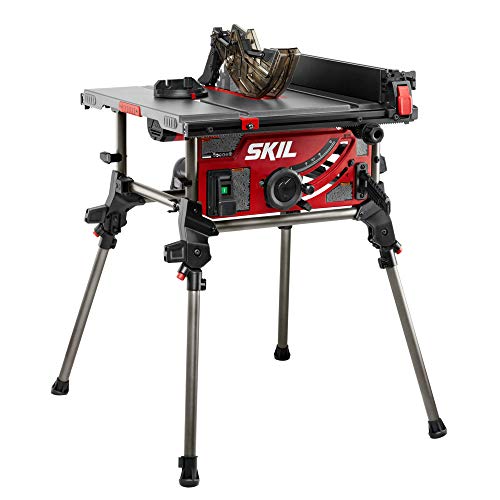
The 51.2 lb TS6307-00 is the only saw in this set a working contractor can load into a truck bed one-handed, and it still runs a rack-and-pinion fence and folds into its own stand.
Best for: solo remodelers who load the saw into a truck every morning Skip it if: you cut sheet goods wider than 25 in daily
The TS6307-00 is the lightest saw here by 25.8 lb. That single figure is why it wins for contractors who work alone. SKIL lists an integrated folding stand whose legs "quickly fold in", a rack-and-pinion fence rated by the brand for accurate parallelism, and a claimed 4x4 cutting capacity at 90 degrees. The bevel is stated at 2 to 47 degrees between two positive stops. The 3-year limited warranty matches the DEWALT and beats the two SawStops and the SKILSAW.
The trade-off is size on the table. This is the entry price position in the set for a reason: SKIL does not publish a wide rip capacity here, and the physical footprint is smaller than the DEWALT or the SKILSAW. If your day is trim, blocking, and stud work, that does not matter. If your day is sheet goods on a deck, it does. The TS6307-00 is also the one buyers choose most often in this shortlist, which tells you the weight-to-capability trade lands where working contractors want it.
Pros:
- Lightest saw here at 51.2 lb
- Integrated folding stand, no separate cart
- Rack-and-pinion fence with parallel micro-adjustment
- 3-year limited warranty
- 4x4 cut capacity at 90° claim
Cons:
- No published rip capacity figure
- Smaller table than the DEWALT or SKILSAW
- Bevel stops at 2° rather than a true 0°
2. DEWALT DWE7491RS — Best for heavy use
The DWE7491RS pairs a 32-1/2 in rip capacity with a rolling stand, and it is the saw to buy if you rip full sheets on-site more days than not.
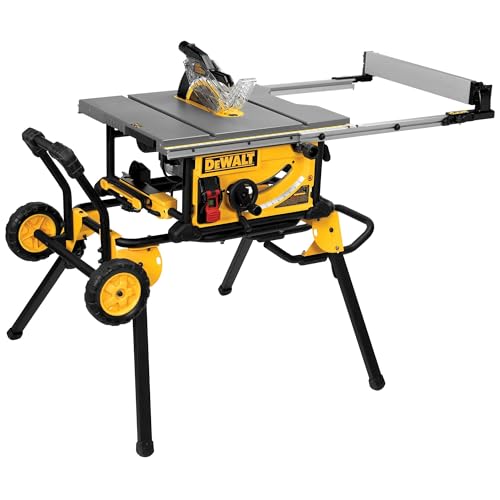
Best for: framing and finish crews running the saw all day Skip it if: you carry the saw upstairs single-handed
At 110 lb, the DEWALT is not the saw you carry up two flights of stairs on your own. It is the saw you wheel across a jobsite, and DEWALT builds the rolling stand for that. The listed rip capacity is 32-1/2 in, which is the widest of any true jobsite saw here. DEWALT rates the motor at 4800 RPM and cites a rack-and-pinion telescoping fence system for "fast, smooth and accurate" adjustments. There is onboard storage for the blade guard assembly, fence, riving knife, miter gauge, wrenches, push stick, and cord wrap.
The 3-year limited manufacturer warranty is the same length as the SKIL and shorter than the Delta. What the DEWALT offers that the SKIL does not is table size and fence range. What it costs, aside from a mid price position in this set, is the two-person lift into a truck bed. If your saw travels but does not travel far, and it earns its keep every day, this is the more productive tool.
Pros:
- 32-1/2 in rip capacity, widest jobsite spec here
- Foldable rolling stand for one-person move
- Onboard storage for guard, fence, gauges
- 3-year limited warranty
- 4800 RPM listed motor speed
Cons:
- 110 lb is a two-person truck-bed lift
- Larger folded footprint than the SKIL
- Warranty shorter than the Delta's 5-year cover
3. SKILSAW SPT99-11 — Most versatile
The worm-drive SPT99-11 posts a 3-5/8 in depth of cut and a 30-1/2 in rip capacity, and it is the pick for crews that hit thick treated lumber daily.
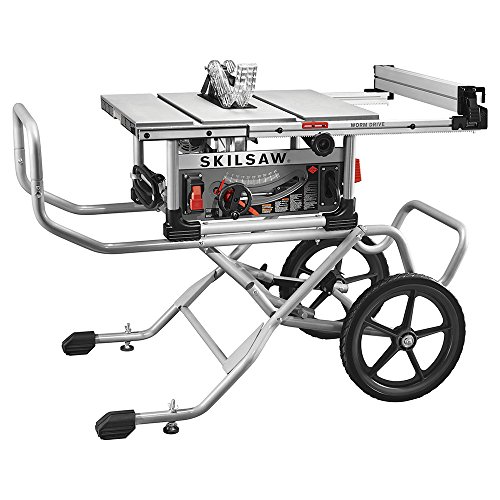
Best for: deck and exterior crews cutting thick treated lumber Skip it if: you want a long warranty on a hard-working tool
The worm-drive gearing is the differentiator. SKILSAW lists a 3-5/8 in depth of cut, which is deeper than the other jobsite saws in this set claim for their 4x4 work, and a 30-1/2 in rip capacity for sheet goods. The rolling stand runs 16-in wheels and easy-load handles, and at 94.3 lb the saw is lighter than the DEWALT by 15.7 lb. SKILSAW also publishes an outfeed and left support that let one person handle larger cuts, which matters on a two-man deck crew where nobody wants to stop cutting to hold a board.
Two figures cost it the top slot. The warranty is 1 year limited, shortest tied with the SawStops. And the mid price position in the set means you pay more than for the SKIL or the Delta without getting the DEWALT's rip capacity. Versatility here means the worm-drive gearing and the deck-friendly cut depth, not a wider fence. If your work looks like decks, joists, and treated stringers, the versatility is real.
Pros:
- Worm-drive gearing for thick lumber
- 3-5/8 in depth of cut, deepest listed here
- 30-1/2 in rip capacity
- 16 in wheels on the rolling stand
- Outfeed and left support for solo cuts
Cons:
- 1-year limited warranty
- Heavier than the SKIL and Delta
- Narrower rip than the DEWALT despite similar footprint
4. Delta 36-6023 — Best for families
The Delta 36-6023 posts a 32.5 in rip capacity, a 13/16 x 8 in stacked dado capacity, and a 5-year professional warranty at an entry price position in this set.
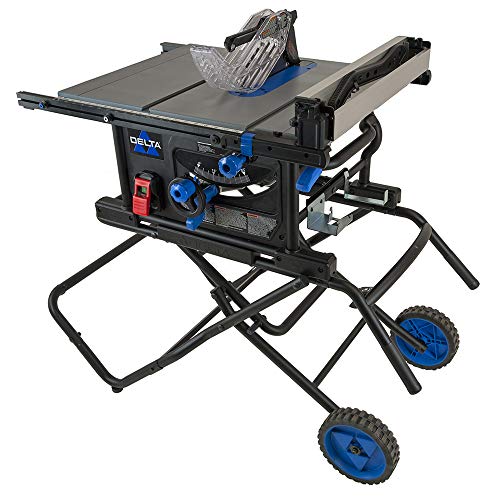
Best for: a home shop that occasionally lands on a paying job Skip it if: you need a rolling stand out of the box
Delta's spec sheet is the surprise of this set. A 32.5 in rip capacity ties the DEWALT for widest fence range. A stacked dado capacity of 13/16 x 8 in opens up joinery the jobsite saws mostly cannot do. The 5-year professional warranty is the longest here by two years, and the price position is second-cheapest of the six. Delta calls the 15-amp motor "contractor grade" and rates it for treated lumber and hardwoods.
The trade-off is mobility. At 77 lb the saw is lighter than the DEWALT, SKILSAW, and both SawStops, but the listing does not include a rolling stand. That is a real difference on-site, where the DEWALT's foldable rolling stand handles the load-in without help. In a garage shop that runs the saw hard on weekends and lands the occasional side job, the Delta is the saw that survives longest for the outlay. Families and homeowners looking at their first serious table saw get more warranty and more capacity per dollar than any other pick here.
Pros:
- 5-year professional warranty, longest here
- 32.5 in rip capacity
- 13/16 x 8 in stacked dado capacity
- Rack-and-pinion fence rails
- Entry price position in this set
Cons:
- No rolling stand included
- Heavier than the SKIL for site work
- Slower seller than the SKIL or DEWALT here
5. SawStop Jobsite Saw PRO — Best for beginners
The Jobsite Saw PRO is the only portable saw here with SawStop's flesh-detection brake, and that changes the math for a new contractor or an apprentice.

Best for: a new contractor or apprentice who wants flesh-detection safety on-site Skip it if: you already own a jobsite saw and just need portability
SawStop lists a 24 5/8 in table depth on the Jobsite Saw PRO, which they call class-leading, and a 25 1/2 in rip capacity on the Hi-Low T-Style fence with Ergolock. The blade guard is an active dust-collection design that captures above-table dust. The mobile cart assembly is included in the model number here, and the stowed dimensions run 26 1/2 in L by 29 in W by 45 in H. Weight is 113 lb.
The reason a beginner should look here is the brake. A trainee makes the mistake that costs a finger, and the safety system is what turns that mistake into a scratch. For anyone hiring or teaching, the case is straightforward. Two figures argue against it for a seasoned solo contractor: the 25 1/2 in rip capacity is the narrowest published fence in the set, and this is a premium price position. The Jobsite Saw PRO is the second-slowest seller here, and the trade you make for the safety system is fence range.
Pros:
- Flesh-detection safety system on a portable saw
- 24 5/8 in table depth
- Active dust-collection blade guard
- Ergolock fence, one-turn blade elevation
- Mobile cart included
Cons:
- 25 1/2 in rip capacity, narrowest here
- Premium price position for a jobsite saw
- No published warranty length in this listing
6. SawStop Contractor Saw — Best premium
At 362 lb with a 52 in T-Glide fence, this is a shop saw. It earns its slot only if the saw never leaves the shop.

Best for: a shop-based finish contractor with a fixed cut station Skip it if: the saw has to leave the shop
The Contractor Saw runs a 1.75-HP motor and a 52 in Professional T-Glide fence, and SawStop cites over 150 configuration options with a mobile base, sliding crosscut table, and router table sold separately. The patented brake stops the blade in under 5 milliseconds and drops it below the table on skin contact. The trunnion and arbor are built for stability, and poly V-ribbed belts reduce vibration.
The obvious cost is weight and price. 362 lb is a stationary tool, and this is the most expensive pick in the set. The 1-year warranty is shortest tied with SawStop's own jobsite saw and the SKILSAW. It is also the slowest seller here, which reflects who buys it: not the working contractor who lives out of a truck, but the finish or cabinet contractor who mills stock in the shop and installs elsewhere. In that setting, the fence, the safety system, and the configurability justify themselves. In any other setting, one of the five saws above is the right tool.
Pros:
- Flesh-detection brake stops blade under 5 ms
- 52 in T-Glide Professional fence
- 1.75-HP motor with V-ribbed belts
- 150+ configuration options
- Cast iron table for flatness
Cons:
- 362 lb, shop-only tool
- Most expensive pick in this set
- 1-year warranty at premium price
- Cast iron wings sold separately
Portable jobsite saw or stationary contractor saw?
Portable jobsite saw or stationary contractor saw is the first decision, and the weight figures in this set draw the line for you. Anything at or below 113 lb is designed to travel. The SawStop Contractor Saw at 362 lb is designed to stay. Between them is a real choice about how your work flows.
A portable jobsite saw earns its keep when the cut station moves with the crew. You set up on the deck, in the driveway, or in a framed room, and the saw comes back to the truck at day's end. The SKIL, DEWALT, SKILSAW, Delta, and SawStop Jobsite Saw PRO all belong here, though only three of them ship with a rolling stand.
A stationary contractor saw earns its keep when the cut station stays put and the work comes to it. Cabinet installers, finish carpenters, and custom trim contractors often run this way: mill parts in a garage or basement shop, install on site with a track saw or a miter saw. If that is your rhythm, the SawStop Contractor Saw is the only pick here built for it. If you spend more days on site than in the shop, buy the portable and put the money into a better fence add-on later.
How much rip capacity do you actually need?
Rip capacity is the number that decides whether you can break down a 4-by-8 sheet on-site in one pass. Half of a 48-in sheet is 24 in. A rip fence has to clear that plus the offcut, or you cut on sawhorses with a track saw instead.
Here is how the six picks line up:
- 25-1/2 in: SawStop Jobsite Saw PRO
- 30-1/2 in: SKILSAW SPT99-11
- 32-1/2 in: DEWALT DWE7491RS
- 32.5 in: Delta 36-6023
- 52 in: SawStop Contractor Saw
- Not published as a fence figure: SKIL TS6307-00
The threshold that matters is 30 in. Below that, you can cut a half-sheet but you cannot rip anything wider than 25 in comfortably. Above 30 in, you have working headroom for door blanks, shelving stock, and full-width plywood strips. The DEWALT and Delta clear that threshold on paper. The SKILSAW clears it too. The SawStop Jobsite Saw PRO does not, which is why the safety system is the reason to buy it, not the fence.
What the listings do not tell you about fences
The listings quote a rip capacity number and a fence type, and both are marketing shorthand. Two things the pages do not tell you decide whether the fence is worth using.
The first is repeatability. A rack-and-pinion fence, which the SKIL, DEWALT, SKILSAW, and Delta all cite, keeps the fence parallel to the blade when you move it. That is the mechanism, not a promise, and every one of those brands calls the result "fast, smooth, and accurate" in near-identical language. Treat it as the manufacturer's claim and check the fence on your first cut against a square.
The second is lock behaviour. SawStop describes the Jobsite Saw PRO fence as "Ergolock" that "slides easily and locks firm with the push" of the lever. That is the only pick in the set that names the lock mechanism specifically. Delta, SKIL, DEWALT, and SKILSAW describe the rails, not the lock. On a jobsite, a fence that shifts a hair under a heavy board is what turns a rip into firewood.
Two things you should plan to check on any saw in this category:
- The fence deflection under hand pressure at the far end, before your first paying cut.
- The blade-to-miter-slot parallelism, which SKIL is alone in publishing a micro-adjustment for.
The verdict
The SKIL TS6307-00 is the best table saw for contractors who work alone and move sites, because 51.2 lb and an integrated folding stand solve the daily problem that decides contractor tool ownership: loading and unloading without a second pair of hands. The 3-year limited warranty is competitive, the rack-and-pinion fence is standard for the category, and it is the one buyers choose most often across this shortlist.
If you run a crew and rip full sheets on-site, the DEWALT DWE7491RS is the better buy. Its 32-1/2 in rip capacity and foldable rolling stand handle sheet goods and site moves that overwhelm the SKIL, and it earns the extra weight. If you cut treated lumber and thick joists all day, the SKILSAW SPT99-11 and its worm-drive gearing with a 3-5/8 in depth of cut is the specialist pick. If the saw lives in your shop and installs go out with a track saw, the SawStop Contractor Saw is the only saw here built for a fixed cut station.
The cutoff between the SKIL and the DEWALT is your daily rip. If most cuts are under 25 in, save weight. If most cuts break down full sheets, take the wider fence.
FAQ
Is the SKIL TS6307-00 powerful enough for contractor work?
The SKIL TS6307-00 draws 15 amps, the same amperage as every other pick in this set, including both SawStops and the DEWALT. SKIL lists a 4x4 cutting capacity at 90 degrees and a 2 to 47 degree bevel range. For framing, blocking, trim, and light sheet work, that is contractor-grade capability. For all-day sheet ripping, the DEWALT or Delta gives you more fence range at the same amperage.
What is the difference between a jobsite saw and a contractor saw?
The difference between a jobsite saw and a contractor saw is portability. A jobsite saw is built to travel: the SKIL at 51.2 lb, the DEWALT at 110 lb, and the SawStop Jobsite Saw PRO at 113 lb all fold or roll. A contractor saw is a bench-height stationary tool built for a shop, like the SawStop Contractor Saw at 362 lb with a 52 in fence. Same category, different work.
DEWALT DWE7491RS or SKILSAW SPT99-11 for a deck crew?
DEWALT DWE7491RS or SKILSAW SPT99-11 comes down to what you cut most. The DEWALT has a wider 32-1/2 in rip capacity for sheet goods and decking boards laid flat. The SKILSAW has worm-drive gearing and a 3-5/8 in depth of cut, which handles thick treated lumber and stringers better. For deck framing, the SKILSAW. For deck surfaces and railings, the DEWALT.
Is the SawStop safety system worth it for professionals?
The SawStop safety system is worth it on any site where an inexperienced hand touches the saw. SawStop cites a blade stop under 5 milliseconds on skin contact. The Jobsite Saw PRO puts that brake on a 113 lb portable. Working solo, on projects you own, with years of muscle memory, the trade is fence range and price. Teaching apprentices or running a crew, the calculus changes.
How long should a contractor table saw last?
A contractor table saw should last as long as the warranty at minimum, and often longer. Delta publishes a 5-year professional warranty on the 36-6023, the longest here. SKIL and DEWALT publish 3-year limited warranties. SKILSAW and both SawStops publish 1 year. Warranty length is a signal of the brand's expectations, and for a tool that earns its keep every workday, that signal is worth reading.
Load the SKIL TS6307-00 into your truck tomorrow and you have a 51.2 lb saw that folds into its stand, rips accurately with a rack-and-pinion fence, and carries a 3-year limited warranty. That combination is the reason it wins here for solo contractors: the specifications match how the work actually happens, not how a catalog photograph looks. If your work involves a crew, sheet goods, and a rolling stand more days than a truck bed and a folding leg, spend the extra weight on the DEWALT and keep the same warranty term. Either way, buy the saw that fits your day, not the one with the longest fence number.